Condividere
Stampa


Condividere
Stampa
Valigia
Architonic ID: 20163953
Anno di Lancio: 1977
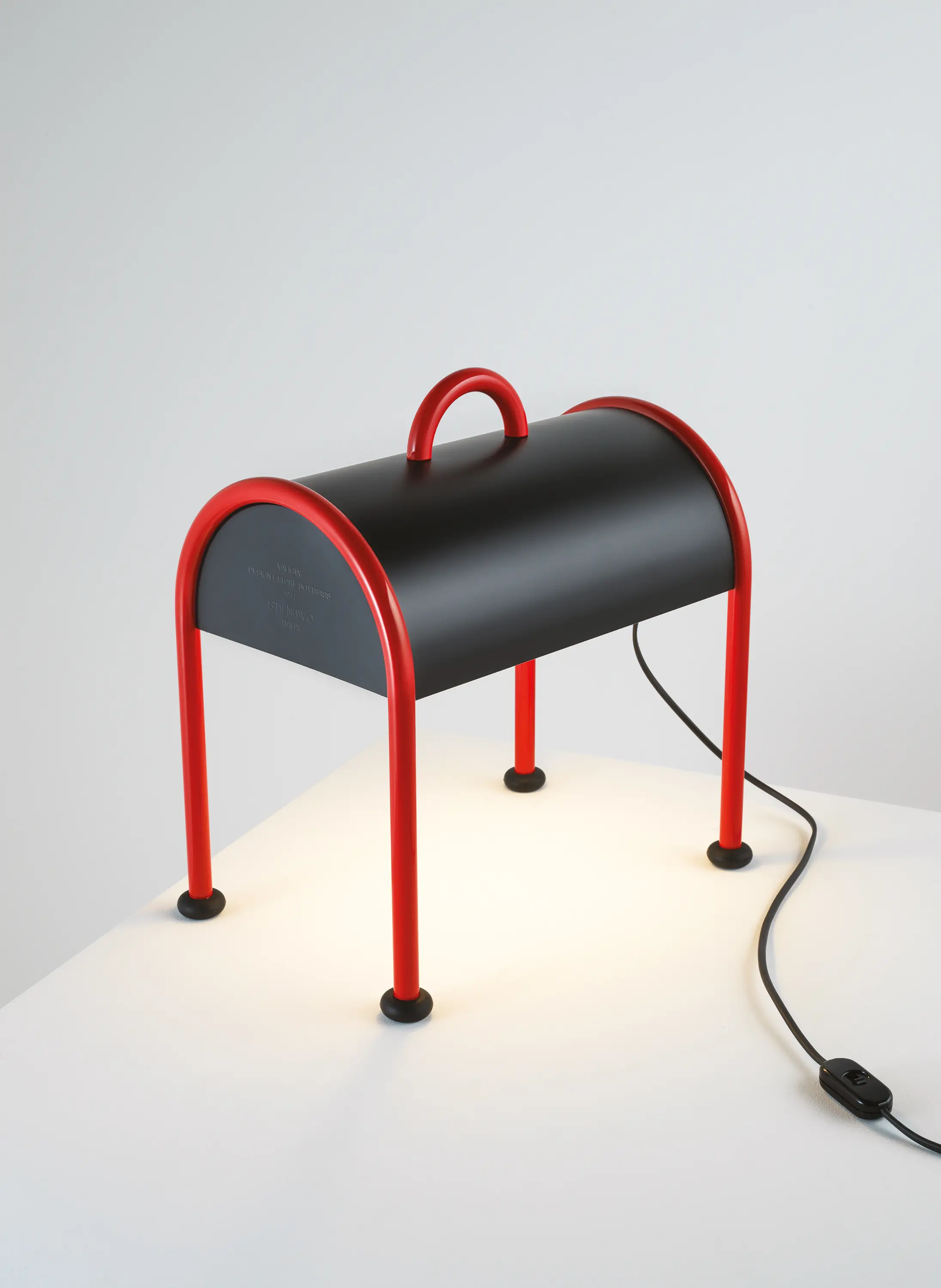
Valigia è ironica e informale: la piccola maniglia e i due archi portanti in tubo rosso sono connessi alla volta in metallo, che contiene la luce. Valigia è una piccola architettura senza confini precisi, dichiaratamente pensata per essere portata ovunque.
Archi portanti e maniglia in metallo verniciato rosso lucido. Paralume a volta in metallo verniciato bicolore nero opaco all’esterno, bianco all’interno. Lampadina LED 7W 2700K E27 inclusa.
Concetto
Valigia è la quinta lampada disegnata da Sottsass per Stilnovo, dopo Ortros, Lampros e Manifesto del 1968, Sinus del 1973 e Don che, come Valigia, risale al 1977.
Valigia è ironica e informale: la piccola maniglia e i due archi portanti in tubo rosso sono connessi alla volta in metallo verniciata esternamente in nero opaco, che contiene la luce. Il rosso e il nero rappresentano una tipica combinazione cromatica amata dal Maestro, tanto da ritrovarla anche in altri suoi progetti. Anche la sezione a volta è una geometria espressiva tipica di Sottsass: una piccola architettura senza confini precisi.
Dichiaratamente pensata per essere portata ovunque, Valigia è una lampada divertente e versatile, un simbolico invito al viaggio.
Metallo

Italy
Ettore Sottsass was one of the most internationally influential designers and architects of the 20th century. Sottsass primarily was known for his furniture and lighting, but also designed numerous other objects, including vases, office equipment, and consumer electronics. He founded the Memphis Group, sometimes known as the Memphis Movement, in 1980, a group of designers and architects that was committed to the colourful, playful style pioneered by Sottsass. Ettore Sottsass: a biography Ettore Sottsass was born on September 14, 1917 in Innsbruck, but grew up in Milan. He studied at the Politecnico di Torino, where he received a degree in architecture in 1939. In 1948 Sottsass returned to Milan to open his own studio for architecture and industrial design. In 1956 he began working with industrial designer George Nelson in New York. That same year, Sottsass began his collaboration with the office equipment manufacturer Olivetti, and gained public recognition for the first time with his design for the Olivetti Elea, an early mainframe computer. In 1959 he won the Compasso d'Oro, Italy’s most prestigious industrial design award for the Elea 9003, which he designed with Roberto Olivetti and the engineer Mario Tchou. In the 1960s, Sottsass travelled extensively in the US and India, and began to design further products for Olivetti. The portable Valentine Typewriter is perhaps his best known work from this period. In 1966 and 1967 he created furniture for the manufacturer Poltronova, experimenting for the first time with coated materials and ceramics. In 1968, the Royal Academy of Art granted Sottsass an honorary degree, in recognition of his immense contributions to the field of design by that point. In 1980, Ettore Sottsass started his own company, Ettore Sottsass Associati, and in the same year founded the Memphis Group with together with various fellow architects and designers. Their work debuted at the Salone del Mobile the following year, but Sottsass left the group in 1985, and it later disbanded in 1989. Sottsass' greatest works have been exhibited extensively, including at the Venice Biennale in 1976, at the Centre Pompidou in Paris in 1994, and at the Design Museum in London in 2007, the year in which he died. Ettore Sottsass’ Typewriter: The Olivetti Valentine In 1969, Sottsass worked with Perry King to design the famous Valentine travel typewriter for Olivetti. With its strong colour and lightweight plastic shell, it remains a symbol of the 1960s pop era. The bright red object quickly became a fashion accessory, bringing colour into the world of work, and becoming an icon of the consumer electronics revolution in the process. West Side Chair by Sottsass The West Side Chair was designed by Ettore Sottsass in the 1980s together with his fellow Memphis Group members. The lounge chairs feature simple shapes and block-like arrangements in bright primary colours. The colours and shapes of the chair, as well as other Memphis Group designs, are reminiscent of the De Stijl movement, referring in particular to the work of the Dutch furniture designer Gerrit Rietveld. The Memphis Movement wholeheartedly rejected functionalist modernism in favour of formal playfulness and fun. These ambitions are highly visible in the West Side Chair, part of the EastsideWestside Collection, which was produced Knoll International. © by Architonic


