Condividere
Stampa

Condividere
Stampa
Kube
Architonic ID: 1001136
Anno di Lancio: 2002
Concetto
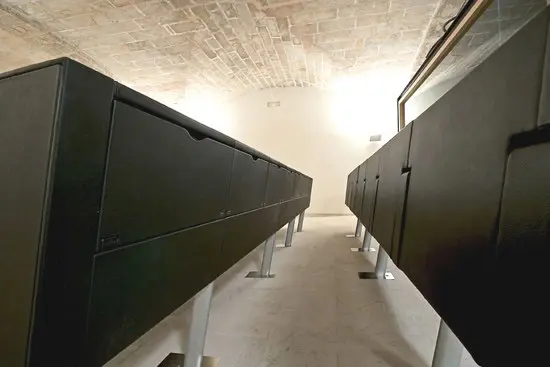
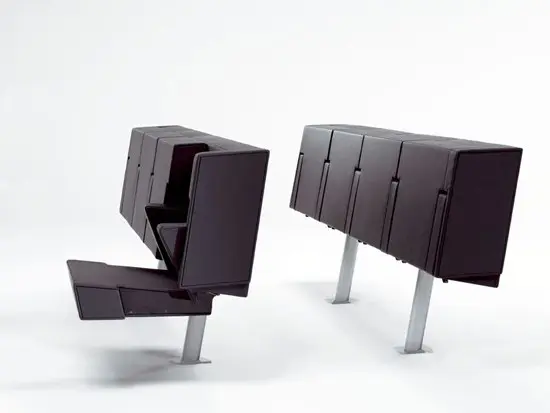
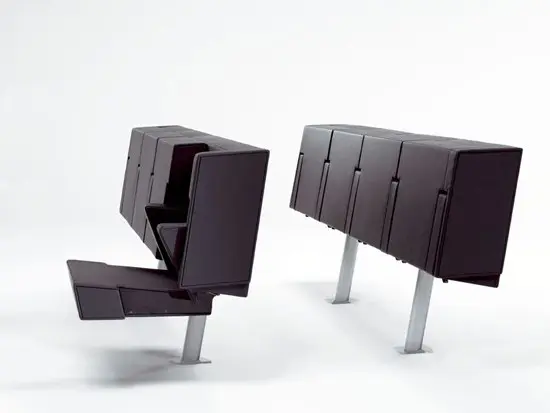
KUBE è un sistema di sedute imbottite su barra fissate a terra. E’ disponibile in diverse configurazioni che lo rendono adatto a sale conferenza, auditorium, teatro e cinema. Il sistema è stato studiato considerando l’impatto che le sedute hanno all’interno di una sala. Il design moderno e rigoroso vuole riprodurre un elemento ''murale'' che si integra nell’architettura complessiva della sala. L’oggetto progettato si può considerare come un grosso parallelepipedo sospeso da terra, dove schienale, sedile e braccioli sono perfettamente integrati. Il bracciolo diventa visibile ed utilizzabile in seguito alla rotazione del sedile. Per un miglior comfort sono previste diverse angolazioni tra sedile e schienale che consentono l’utilizzo ottimale per varie soluzioni (ad esempio, sale conferenze, sale proiezioni). Di conseguenza è prevista anche la regolazione del piede di fissaggio a terra. Le sedute possono essere montate anche su pavimenti inclinati o a gradoni. Tutti i meccanismi di ribaltamento sedile e bracciolo sono provvisti di cuscinetti in nylon antirumore e gli elementi fissati sulla barra portante possono essere sostituiti velocemente. Il sistema è predisposto per il passaggio di cavi, gli impianti di traduzione simultanea e di votazione. E’ disponibile la versione con tavoletta posteriore integrata nello schienale e bracciolo con tavoletta antipanico. Sono inoltre disponibili diversi accessori quali il portaborse/riviste e l’appendiabiti. Il sistema risponde alle norme vigenti in materia di: anti-fuoco, acustica, sicurezza, resistenza, ergonomia. I rivestimenti previsti sono pelle o tessuto, mentre la parte posteriore dello schienale può essere in acciaio verniciato o in pannelli di legno. La gamba viene finita con verniciatura a polveri ad alta resistenza. Il terminale di ogni fila può avere la numerazione illuminata ed è previsto il segnaposto su ogni schienale. Il sistema prevede l’utilizzo di barre a 2, 3, 4 e 5 posti. Nella configurazione in curva è prevista la gamba di sostegno ad ogni posto.
Meeting, Contract, Cultura, Ufficio

Austria
Profile Gernot Bohmann was born in 1968 in Krieglach/Styria, Harald Gründl in 1967 in Vienna and Martin Bergmann in 1963 in Lienz/East Tyrol. After their graduation from the University of Applied Arts in Vienna, they founded EOOS in 1995. EOOS operates in the fields of furniture and product design as well as shop design for clients such as Giorgio Armani, Adidas, Alessi, Bite Beauty, the Bill & Melinda Gates Foundation, Bulthaup, Carl Hansen & Søn, Dedon, Duravit, Geiger, Herman Miller, Hussl, Keilhauer, Lamy, MatteoGrassi, Poltrona Frau, Walter Knoll and Zumtobel. For EOOS, design is a poetical discipline between archaic and high-tech. EOOS examines rituals, myths and intuitive images as a starting point within the scope of the Poetical Analysis®. In 2015 the MAK – Austrian Museum of Applied Arts / Contemporary Art – celebrated the work of EOOS with the first major solo exhibition. In this context the monograph “by: EOOS” (Birkhäuser/Basel) was released. To date, EOOS has over 15 technical patents and received more than 130 international awards, including the 2004 renowned Italian Compasso d'Oro for Kube, produced by MatteoGrassi. In 2007, the EOOS-founders were nominated of the Austrian Broadcasting Corporation (ORF) and the readers of the daily newspaper "Die Presse" to "Austrians of the Year" in the Creative Industries. In 2010, EOOS received for b2 the mobile workshop kitchen, produced by bulthaup the Design Award of the Federal Republic of Germany in gold. In 2012 the shower OpenSpace, made by Duravit, won the "Best of the Best" red dot Award, the German Design Award and the IF Award in gold. For the redesign of a toilet EOOS received a "Special Recognition for Outstanding Design" from the Bill & Melinda Gates Foundation. Jaan bed, a bed series, produced by Walter Knoll was honored as best bed 2015 by Wallpaper*. EOOS also won the best of Neocon Gold award for Juxta and Cahoots, produced by Keilhauer.