Condividere
Stampa



Architonic ID: 1026629
Anno di Lancio: 2003
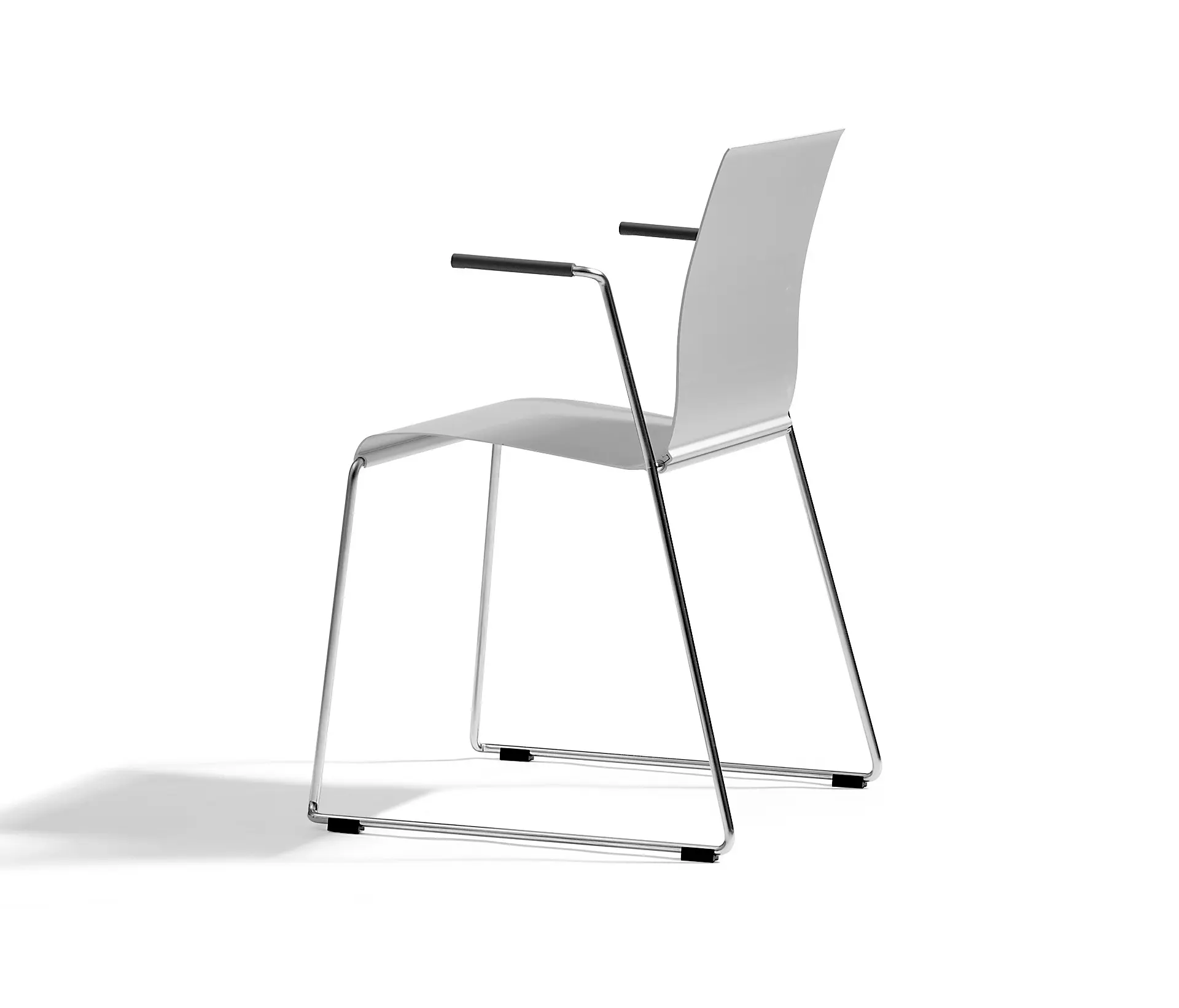
Sting is back! Made in just two materials: aluminum and stainless steel. At home indoors as well as outdoor. Sting has that perfect tilt of the backrest. Now Fredrik Mattson and Stefan Borselius’ stackable and linkable chair is back in business with the same exact profile and its very precise graphic language.
Concetto
Sting O30A
Sting is an exceptionally stackable chair in aluminium and stainless steel. Sting is linkable and can be used both indoors and outdoors.
Sting is very comfortable with a slight movement and is usable in many different environments; indoors, outdoors, cafés, canteens, conference centres and more. Sting is also available as armchair. Sting natural anodised is eco-labelled with the Nordic Swan and is 100 % recyclable. Use our design tool to configure your own Sting!
Sting is the result of an extremely manufacturing-orientated design process. The result is a common chair in an unusual way. The seat and backrest of Sting is made of aluminium that is extruded in lengths up to 60 metres long. The lengths are later sliced into pieces and anodised; becoming seats and backs of chairs. As far as we know, in 2003 when we presented Sting, it was the first chair on the market where this technique was used. The seat and the backrest section are jointed together almost invisibly. No screws are needed, the stainless steel legs fixates the frame and locks the construction.
Stacks up to 50 pieces in a trolley
Can be used outdoors as well as indoors
Also available lacquered
Available with different seatpads
Linkable
Available in light weight, 4.5 kg
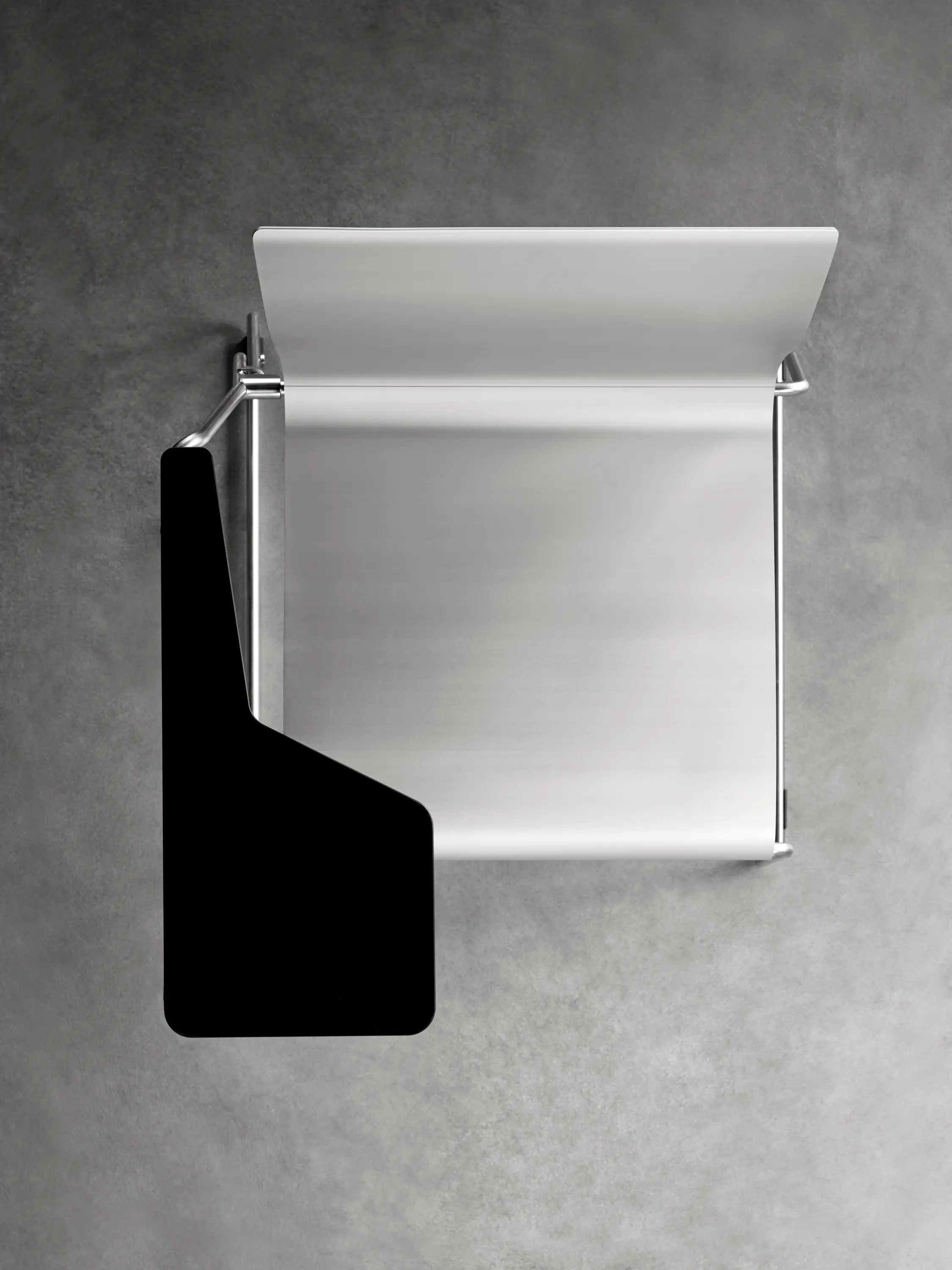
Foldable and removable writing table
Material:
Seat and back in anodised aluminium. Legs in stainless steel. Acetal plastic feet.
Measurements (mm):
Seat height 455
Overall height 810
Overall width 530
Seat depth 400
Overall depth 540
Weight, kg 6,0
Light weight, kg 4,5
Cbm 0,29/4 pcs
Questo prodotto appartiene alla collezione:
Alluminio, Base metallo, Metallo, Seduta metallo, Inox

Sweden
born 1973 in Malmö. Educated at the Konstfack University College of Arts, Crafts and Design. He attended Steneby school and studied furniture carpentry and design. Fredrik Mattson is a dynamic, questioning and curious designer who never says No, but often – Yes, that could work, or this, or that... He never closes any doors but constantly opens new, unexpected ones. His interest in new materials and techniques goes hand in hand with a genuine knowledge of tradition and handicrafts which result in products with strong, clear characteristics and no compromises on quality. Fredrik isn’t attracted by a specific style, but rather by the energy and conviction which characterise an object. Through his creativity he strives to achieve clarification and is quite happy to challenge convention. He has a sense of humour and is talkative, but above all he is an amazing designer who has received several prizes and distinctions. Awards & Others Nominated for the “German Design Award” (announced 2006) 2005 Forsnäsprize, Sweden 2005 Pagrotskyrummet, Sweden 2005 Represented at National museum of Sweden, Stockholm 2004 Red Dot, best of the best, Germany 2004 Architectural Review Award, London, England 2004 Product of the year, Sköna Hem, Sweden 2004 Nominated for the FutureDesignDays Award, Sweden 2003 Winner of the Swedish EDIDA award, Sweden 2003 Architectural Review Award, London, England 2003 Golden chair, Swedish architect award, Sweden 2002 Den Nordiska första S:t Johannis_Logens Jubelfond, Sweden 2002 Young Swedish design Award, Sweden Selected exhibitions 2005 40/4 forty years of forty/four, Howe, Stockholm Sweden 2005 Galerie Pascale Cottard-Olsson, Sweden 2005 H55/05 Allrum, Helsingborg, Sweden 2005 Salone Del Mobile, Milan, Italy 2005 Stockholm furniture fair, Sweden 2005 Swedish Style, Tokyo, Japan 2005 Spectrum, London, England 2005 “Made in Malmö” Form Design Center, Malmö, Sweden 2004 "Design in Sweden" Museum of London, Museum of Docklands, England 2004 Stockholm furniture fair, Sweden 2004 Salone Del Mobile, Milan, Italy 2004 Spectrum, London, England 2004 Galerie Pascale Cottard-Olsson, Sweden 2004 Swedish Style, Tokyo, Japan 2003 Stockholm furniture fair, Sweden 2003 Svezia Light, Milan, Italy 2003 Salone Del Mobile, Milan, Italy 2003 Stockholm furniture fair, Sweden 2002 1900-2002 Svensk form, internationell design, Sweden 2002 Form Design Center, Malmö, Sweden 2002 Biennale Design Saint-t Étienne, France 2002 Swedish council, New York, USA 2002 Galleri Moroten Stockholm 2002 Stockholm furniture fair, Sweden 2001 Kulturhuset, Stockholm, Sweden 2001 Stockholm furniture fair, Sweden 2001-2002,Young Swedsh design Malmö, Stockholm, Göteborg, Sweden 2000 Stockholm furniture fair, Sweden 2000 Stockholm furniture fair, Sweden 1999 Rhööska museet Göteborg 1999 Stockholm furniture fair, Sweden Education Konstfack, Master of Fine Arts, Interior Architecture at School of Arts, Craft and Design in Stockholm, MFA Stenebyskolan, Bachelor of Fine Arts (furniture design) Buckinghamshire Chilterns University (exchange student) Grebbestad FHS –Cabinetmaker
Sweden
born 1974 in Malmö. Educated at the Konstfack University College of Arts, Crafts and Design. He attended Carl Malmstens school and Steneby school, and studied furniture carpentry and design. Stefan Borselius is an ingenious designer with a head bursting with ideas. He can be quiet and thoughtful, but when he speaks out he’s quite the verbal gymnast, an art he balances with being an equally inventive and an aesthetically pleasing designer. Stefan’s choice of career was inspired by his grandfather and great grandfather who were both skilled furniture carpenters. Stefan prefers to call himself a carpenter, and he believes that hands, thoughts and precision are all important tools of his occupation. Right from the function and material of an object through to the final product, Stefan wants to create furniture for our time and our way of living, our here and our now. When he works with a product, Stefan Borselius leaves nothing to chance, but goes methodically and whole- heartedly through every single detail, every function and every characteristic which a material or a technique can offer. He pushes the boundaries of what is possible to produce, and would rather give up and pursue another route than not produce anything at all. He leaves no stone unturned in his quest for a solution. As a result, his products have a strong sense of identity which already answer unasked questions in their strong expressionism.


