

Condividere
Stampa

Condividere
Stampa
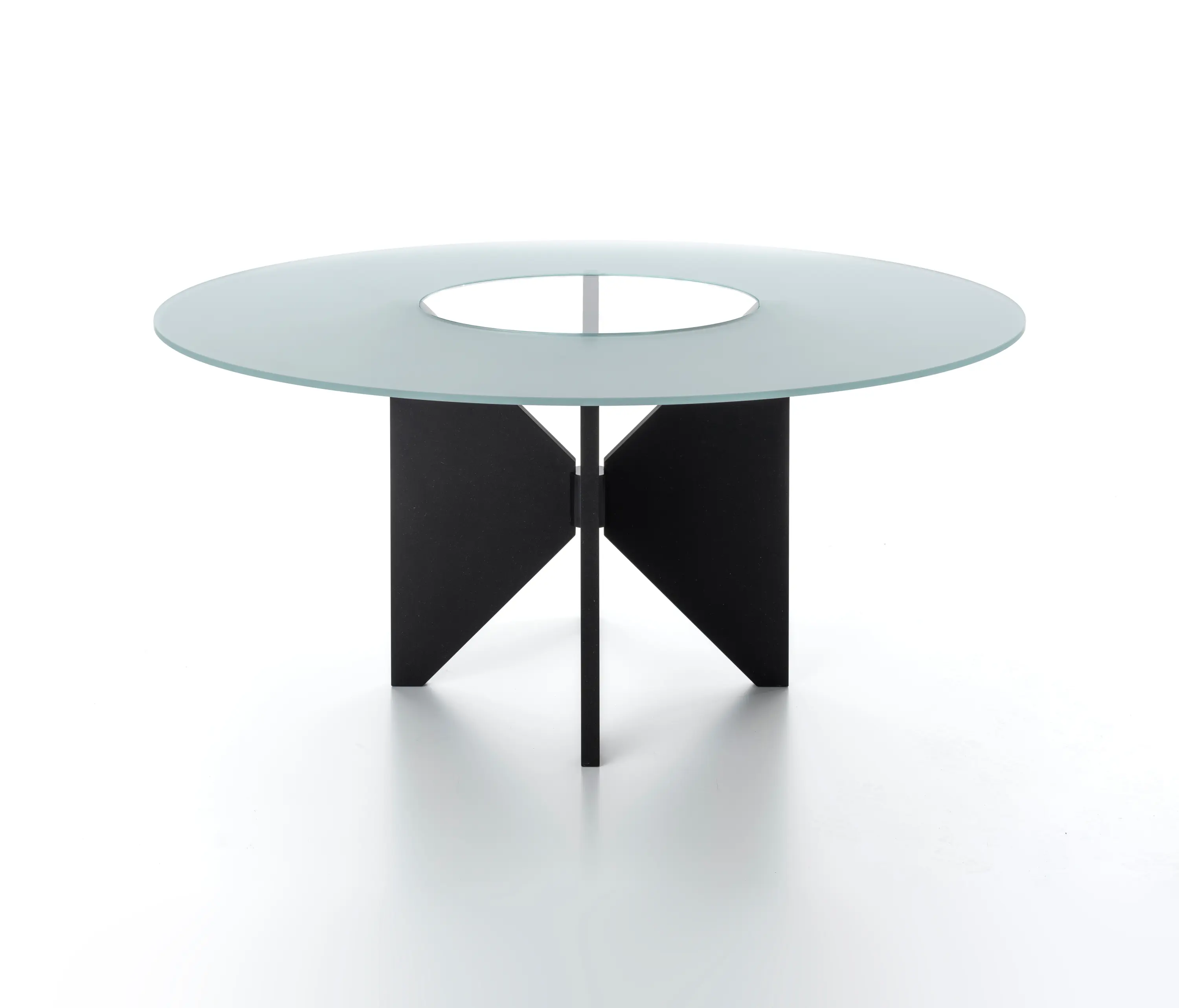
Saturno table
Architonic ID: 20326922
Anno di Lancio: 2025
avolo rotondo con base composta da 4 elementi in MDF Valchromat® (colorato in massa e verniciato trasparente) fissati ad un elemento strutturale cilindrico in acciaio verniciato nero lucido.
Piano disponibile in 3 misure: cm Ø140-160-180.
Il piano del tavolo è composto da due elementi: un pianetto tondo centrale (sempre in vetro extra-chiaro trasparente) e una corona esterna disponibile in:
- MDF Valchromat® abbinato alla base, sp. 16 mm (la corona è realizzata giuntando 4 sezioni)
- vetro acidato sp. 12 mm (solo per cm Ø140-160)
- marmo bianco Carrara sp. 15 mm (solo per cm Ø140-160)
Il tavolo è disponibile nella versione esclusiva MB edition: base grigio chiaro con profili neri, piano Ø160 in vetro acidato.
Concetto
Con la collezione SATURNO, Alias rinnova la collaborazione con l'architetto ticinese, avviata negli anni ’80. Il sistema di tavoli e tavolini è caratterizzato da un design architettonico in un sapiente equilibrio tra pieni e vuoti che conferisce al prodotto leggerezza e dinamicità visiva. La solida base centrale caratterizza l’intera collezione: quattro elementi in MDF colorato in massa sono ancorati ad un cilindro in acciaio verniciato a polvere nero lucido. Il risultato è una struttura scultorea tipica del linguaggio architettonico di Botta, sulla quale si appoggiano piani, proposti in diverse dimensioni e finiture.
Nella versione ad altezza 72 cm, il piano è composto da una corona esterna, in varie finiture e da un pianetto tondo in vetro extra-chiaro trasparente che, come un lucernario in architettura, permette alla luce di attraversare la superficie, illuminando la base scultorea e creando un raffinato gioco di trasparenze.
Nel tavolino Saturno 48, la base si riduce proporzionalmente rispetto al dining table e accoglie un piano proposto in vetro o in pietre naturali.
Questo prodotto appartiene alla collezione:
Base legno derivato, Legno derivato, Vetro, MDF pannello di fibra media densità, Piano vetro, Legno
Puoi visitare la pagina del prodotto per queste varianti: basta cliccarci sopra!

Switzerland
Mario Botta, Architect Born in Mendrisio, Ticino, on April 1, 1943. After an apprenticeship in Lugano, he first attends the Art College in Milan and then studies at the University Institute of Architecture in Venice. Directed by Carlo Scarpa and Giuseppe Mazzariol he receives his professional degree in 1969. During his time in Venice he has the opportunity to meet and work for Le Corbusier and Louis I. Kahn. His professional activity begins in 1970 in Lugano. He builds his first single-family houses in Canton Ticino and subsequently all over the world. He has always committed himself in an intense architectural research and since 1996 he is involved as creator and founder of the new academy of architecture in Mendrisio, Ticino where he is Professor and held the directorship in 2002/2003. His work has been recognized with important awards such as the Merit Award for Excellence in Design by the AIA for the Museum of Modern Art in San Francisco; the International Architecture Award 2006 by the Chicago Athenaeum Museum of Architecture and Design and the “European Union Prize for Cultural Heritage Europa Nostra”, The Hague (The Netherlands) for the restructuring of the Theatre alla Scala in Milan; the International Architecture Award 2007 by the Chicago Athenaeum Museum of Architecture and Design for the Church Santo Volto in Turin and the wellness centre Tschuggen Berg Oase in Arosa. His work has been presented in many exhibitions. Among his realizations must be remembered the theatre and cultural center André Malraux in Chambéry, the library in Villeurbanne, the SFMOMA museum in San Francisco, the cathedral in Evry, the museum Jean Tinguely in Basel, the Cymbalista synagogue and Jewish heritage centre in Tel Aviv, the municipal library in Dortmund, the Dürrenmatt centre in Neuchâtel, the MART museum of modern and contemporary art of Trento and Rovereto, the Kyobo tower and the Leeum museum in Seoul, the office buildings Tata Consultancy Services in New Delhi and Hyderabad, the museum and library Fondation Bodmer in Cologny, the church Papa Giovanni XXIII in Seriate, the restoration of the Theatre alla Scala in Milan, the new casinò in Campione d’Italia, the church Santo Volto in Turin, the wellness centre Tschuggen Bergoase in Arosa, the Campari headquarters in Sesto San Giovanni, the winery Château Faugères in Saint-Emilion and the Bechtler museum in Charlotte, USA.


