

Partager
Imprimer

Partager
Imprimer
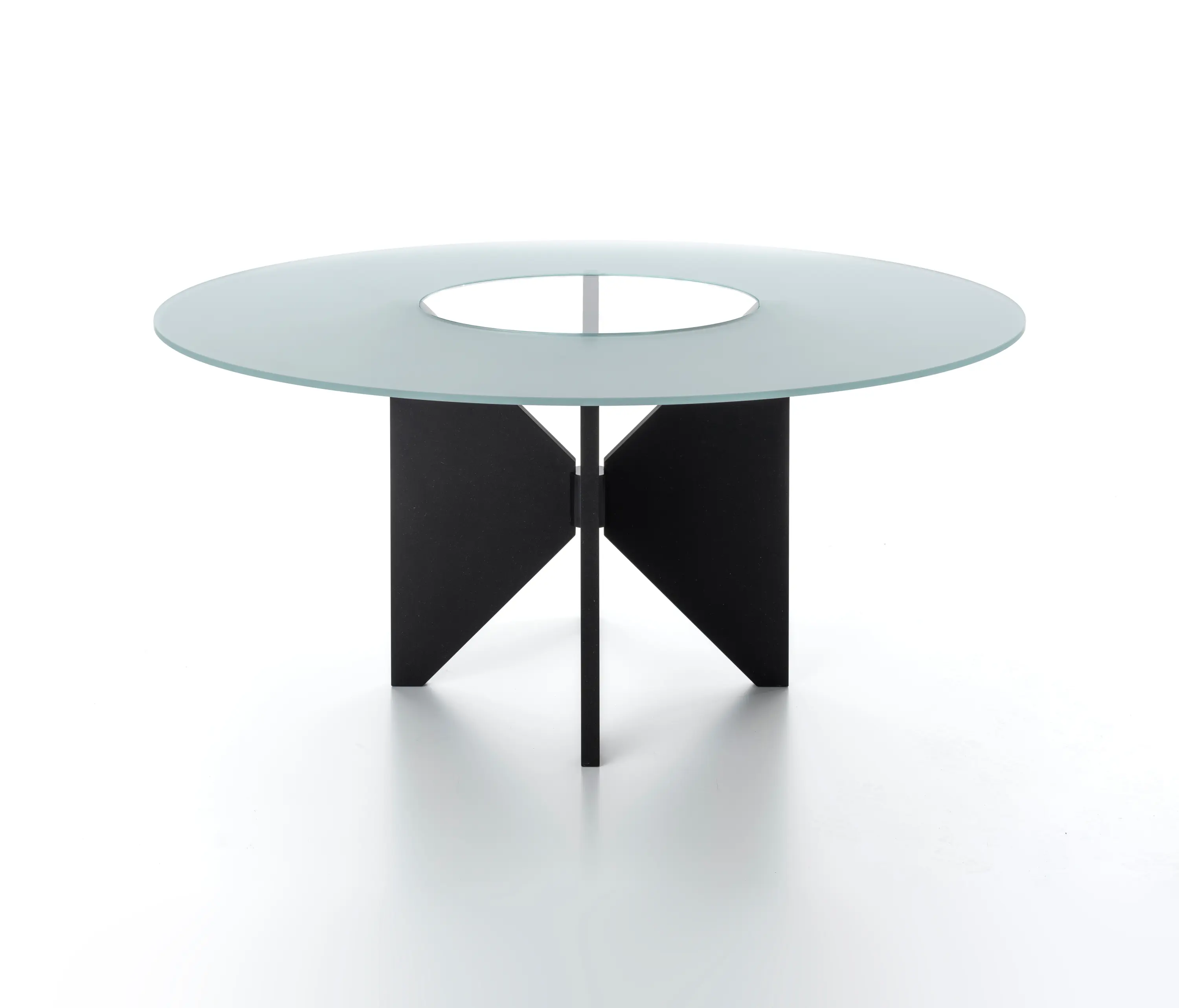
Saturno table
Architonic ID: 20326922
Année de Lancement: 2025
Table ronde avec base composée de 4 éléments en MDF Valchromat® (teinté dans la masse et laqué transparent) fixés à un élément structurel cylindrique en acier laqué noir brillant.
Le plateau est disponible en 3 dimensions : cm Ø140-160-180.
Le plateau de table se compose de deux éléments : un plateau rond central (toujours en verre transparent extra-clair) et une couronne externe disponible en :
- MDF Valchormat® assorti à la base, ép. 16 mm (la couronne est réalisée en assemblant 4 sections)
- verre gravé ép. 12 mm (uniquement pour Ø140-160 cm)
- marbre bianco Carrara, ép. 15 mm (uniquement pour Ø140-160 cm)
La table est disponible dans la version exclusive MB edition : base gris clair avec profils noirs, plateau Ø160 en verre gravé.
Concept
Avec la collection SATURNO, Alias renouvelle la collaboration avec l'architecte tessinois entamée dans les années 1980. Le système de tables et de tables basses se caractérise par un design architectural dans un savant équilibre de pleins et de vides qui confère au produit légèreté et dynamisme visuel. La base centrale solide caractérise toute la collection : quatre éléments en MDF teinté dans la masse sont ancrés à un cylindre en acier laqué en poudre noir brillant. Le résultat est une structure sculpturale typique du langage architectural de Botta, sur laquelle reposent les plateaux, proposés en différentes tailles et finitions. Dans la version de 72 cm de haut, le plateau est composé d'un élément circulaire en forme de couronne, et un plateau rond en verre extra-clair. Comme un puits de lumière en architecture, ce plateau laisse passer la lumière à travers la surface, en éclairant la base sculpturale et en créant un jeu de transparences raffiné. Dans la table basse Saturno 48, la base est proportionnellement plus petite que la table dining et accueille un plateau proposé en verre ou en pierres naturelles.
Ce produit appartient à la collection:
Piétement dérivé du bois, Dérivé du bois, Verre, MDF panneau de fibres densité moyenne, Plateau de table verre, Bois
Vous pouvez visiter la page produit de ces variantes : cliquez simplement dessus !

Switzerland
Mario Botta, Architect Born in Mendrisio, Ticino, on April 1, 1943. After an apprenticeship in Lugano, he first attends the Art College in Milan and then studies at the University Institute of Architecture in Venice. Directed by Carlo Scarpa and Giuseppe Mazzariol he receives his professional degree in 1969. During his time in Venice he has the opportunity to meet and work for Le Corbusier and Louis I. Kahn. His professional activity begins in 1970 in Lugano. He builds his first single-family houses in Canton Ticino and subsequently all over the world. He has always committed himself in an intense architectural research and since 1996 he is involved as creator and founder of the new academy of architecture in Mendrisio, Ticino where he is Professor and held the directorship in 2002/2003. His work has been recognized with important awards such as the Merit Award for Excellence in Design by the AIA for the Museum of Modern Art in San Francisco; the International Architecture Award 2006 by the Chicago Athenaeum Museum of Architecture and Design and the “European Union Prize for Cultural Heritage Europa Nostra”, The Hague (The Netherlands) for the restructuring of the Theatre alla Scala in Milan; the International Architecture Award 2007 by the Chicago Athenaeum Museum of Architecture and Design for the Church Santo Volto in Turin and the wellness centre Tschuggen Berg Oase in Arosa. His work has been presented in many exhibitions. Among his realizations must be remembered the theatre and cultural center André Malraux in Chambéry, the library in Villeurbanne, the SFMOMA museum in San Francisco, the cathedral in Evry, the museum Jean Tinguely in Basel, the Cymbalista synagogue and Jewish heritage centre in Tel Aviv, the municipal library in Dortmund, the Dürrenmatt centre in Neuchâtel, the MART museum of modern and contemporary art of Trento and Rovereto, the Kyobo tower and the Leeum museum in Seoul, the office buildings Tata Consultancy Services in New Delhi and Hyderabad, the museum and library Fondation Bodmer in Cologny, the church Papa Giovanni XXIII in Seriate, the restoration of the Theatre alla Scala in Milan, the new casinò in Campione d’Italia, the church Santo Volto in Turin, the wellness centre Tschuggen Bergoase in Arosa, the Campari headquarters in Sesto San Giovanni, the winery Château Faugères in Saint-Emilion and the Bechtler museum in Charlotte, USA.


