





Detalles de contacto
Enviar un mensaje
Llámanos
Distribuidores

Architonic ID: 1002790
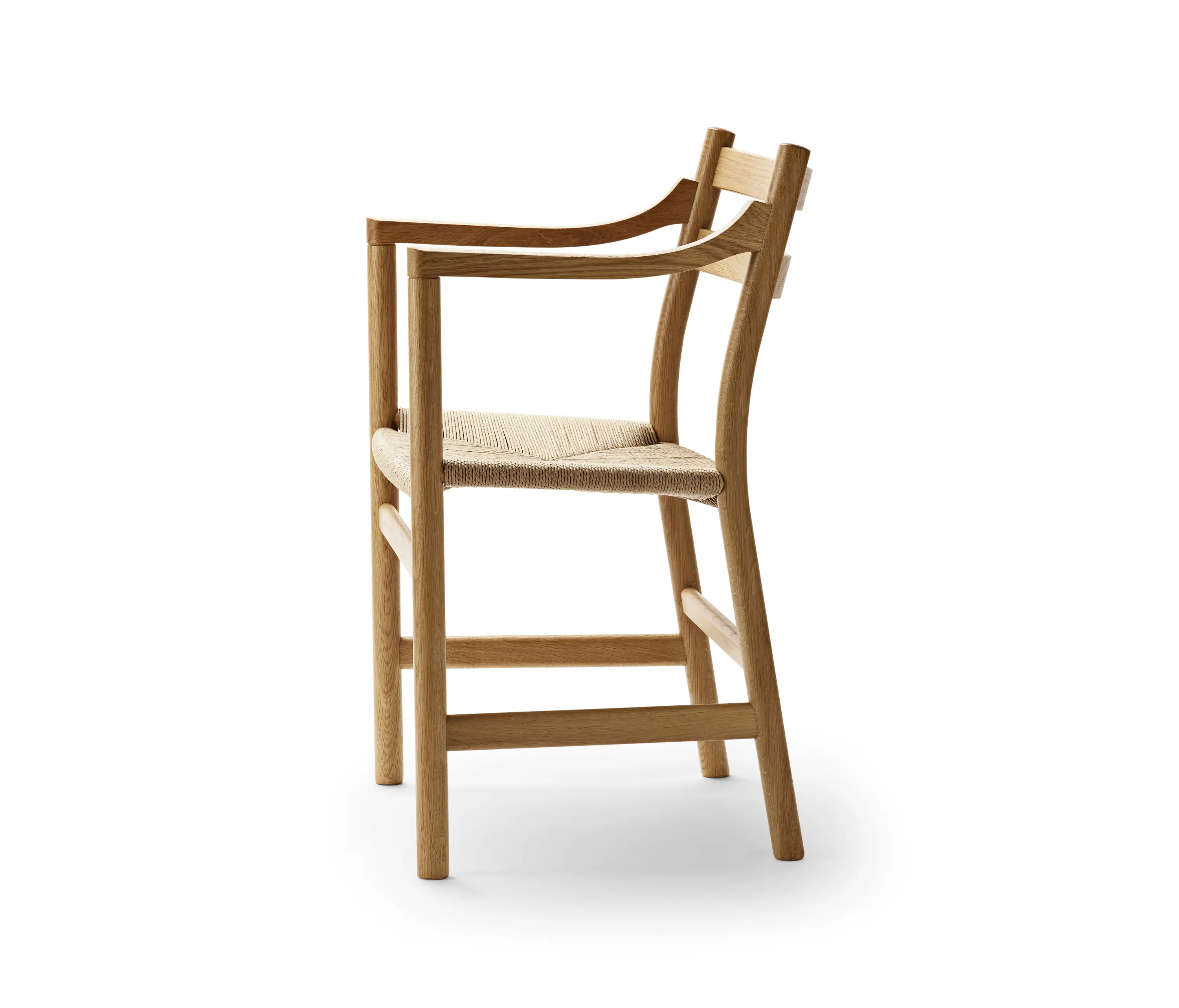
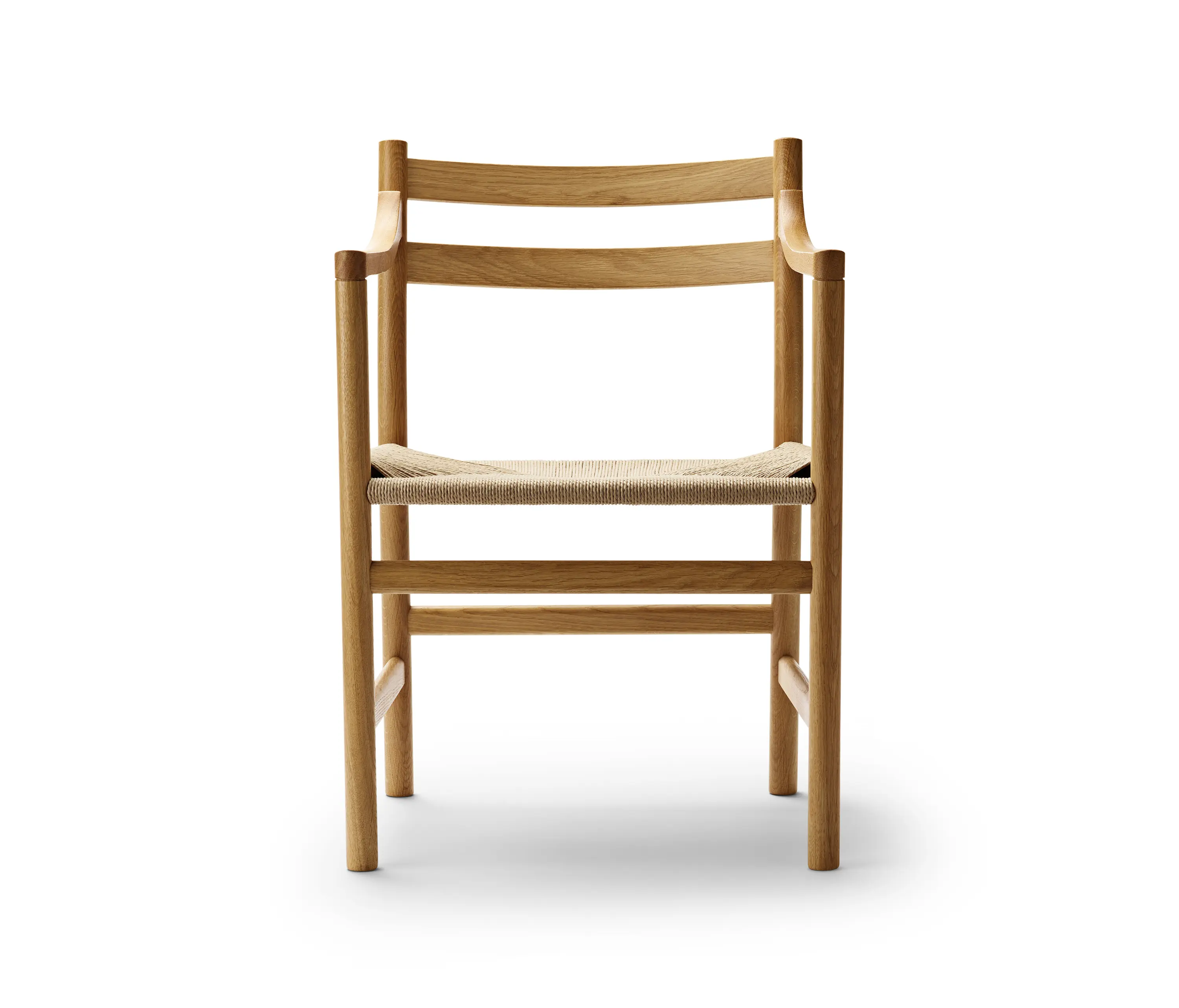
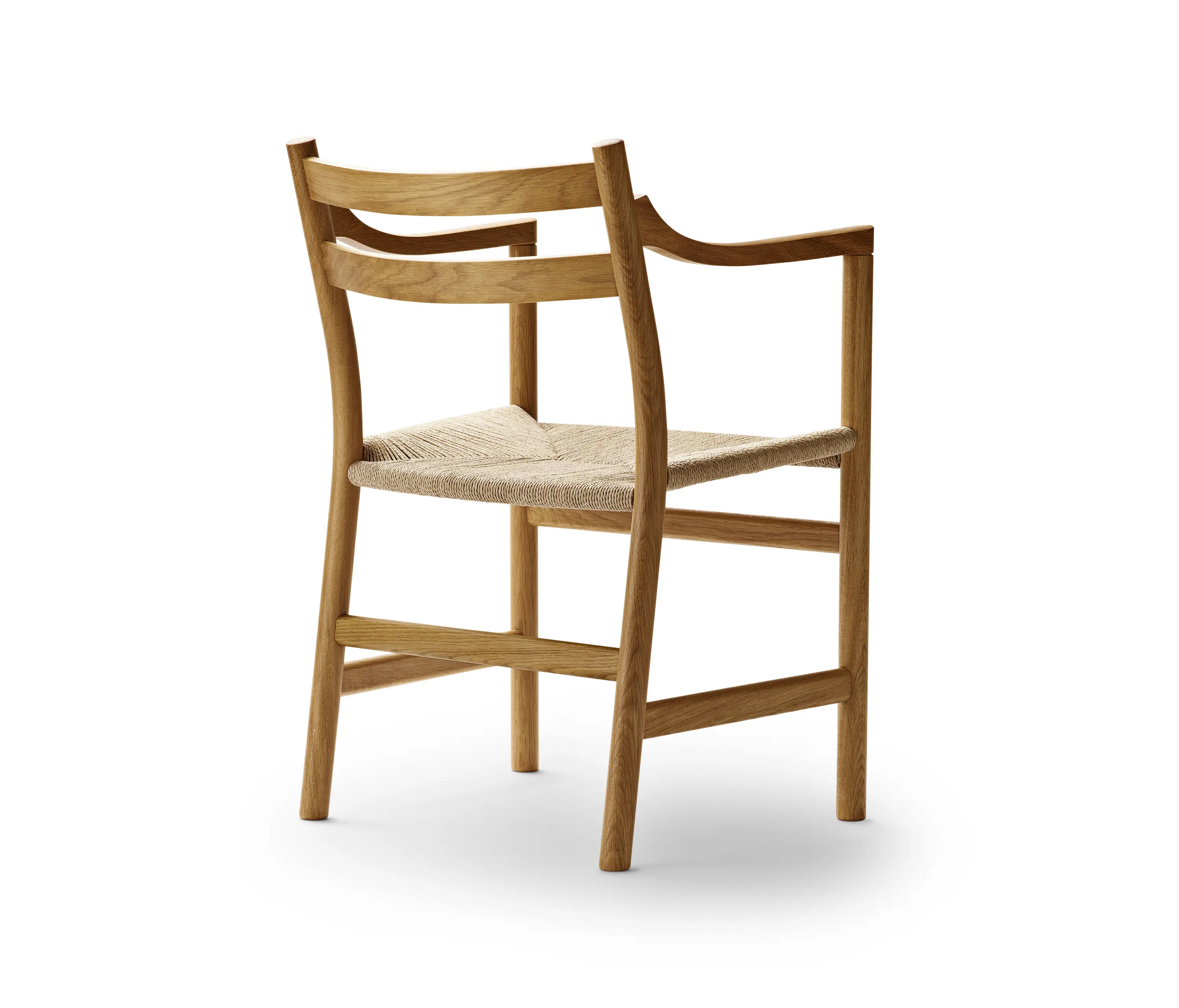
The CH46 armchair is a good example of how Hans J. Wegner often used the same design idea in furniture with different functions.
Hans J. Wegner´s CH46 chair is simple and functional, but, at the same time, also elegant. One senses that Wegner could be inspired by the simple chairs of Southern Europe and the American Shaker movement, but he has personalized his inspiration.
Ergonomics was an essential consideration for Wegner in his designs. Careful coordination between slopes and proportions ensured that each chair was optimally suited for the human body. The choice of curved hind legs plays an important role in the construction and balance of the chair. The rearward bending at the top ensures a comfortable incline of the backrest, while the angle of the bottom ensures that the chair cannot fall backwards. The chair seat is woven from paper cord and the two backrest bars are laminated from 3 different thicknesses of wood which are then curved into a soft but tense bow shape. At the front, the armrest has the same elegant rounding as the front leg while curving slightly upwards toward the back where it is firmly fastened between the two backrest bars. The legs and armrests have a slightly arched surface.
The comfortable armrest, the good back support and the handwoven seat in paper cord, all incorporated in a timeless design, make CH46 comfortable and suitable for the dining room, conference rooms and waiting rooms.
When Carl Hansen & Søn started working on CH46 in 1966, Wegner also gave them the drawing for a chair without armrests, model number CH47. CH46 and CH47 are related to Wegner’s lounge chair CH44 from 1965.
FSC™-certified oak, oil, natural paper cord
Este producto pertenece a la colección:
Base madera maciza, Materiales naturales, Roble, Asiento materiales naturales, Asiento tejido, Madera
Puedes visitar la página del producto para estas variantes, ¡simplemente haz clic en ellas!

Denmark
Hans J Wegner was one of the world's most famous furniture designers in the 20th century, and one of the driving forces behind the rise and influence of Danish design. The Life of Hans J Wegner Hans J Wegner was born on 2 April, 1914, in Tønder, Denmark. His talent for wood carving was recognised early on, during his apprenticeship as a carpenter. He went on to study design and also architecture at what would later become the Royal Danish Academy of Fine Arts in Copenhagen, where he taught furniture design between 1946 and 1953. In 1940, he initiated a project to fit out the Town Hall of Aarhus, together with fellow architects Erik Moller and Arne Jacobsen. That same year, Wegner began collaborating with the master cabinetmaker Johannes Hansen. The Danish Museum of Art & Design first bought one of Wegner’s chairs in 1942; but his most popular chair was the 1949 Wishbone Chair which has been produced since 1950 by Carl Hansen & Son. In 1982, Hans J Wegner won the CF Hansen Medal for architecture, the highest award for the discipline in Denmark; and in 1997 he won the 8th International Design Award in Osaka. He was also awarded with an honorary doctorate from the Royal College of Art in London in 1997. Hans J Wegner’s design approach Hans J Wegner was one of the most creative and productive furniture designers of his time. He designed numerous chairs, living-room furniture, dining tables and other home furnishings. He was best known for his chairs however; and following his motto ‘a chair is a chair only if someone sits on it’, Wegner united form and function with his chairs, and brought Scandinavian design to the fore. Wegner was concerned not only with the appearance of a chair, but with its function – to support the human body. Hans J Wegner's creativity and his extraordinary sense for sculptural expression made him the pioneer of Danish modernism. His approach to minimalism was inspired by the material properties of wood, and the sculptural, organic forms found in nature. For Wegner, the experience of a chair was not limited to the merely visual; it should be an artwork that appeals to all the senses, touch included. Hans J Wegner’s CH24 Wishbone Chair The CH24 Wishbone Chair, also known as the Y-Chair, is one of Hans J Wegner’s most successful designs. He created it for Carl Hansen & Son, who have produced it since the 1950s, as part of a series of chairs inspired by antique Chinese armchairs. The characteristic element that gives the chair its name is a Y-shaped, clavicle-like element supporting the backrest. The ergonomic design and strong, structural form of the Wishbone Chair have made it a design classic, and the chair became world famous when, in 1961, it was used during a TV debate between John F Kennedy and Richard Nixon. The CH25 Lounge Chair: a Danish design icon The CH25 Lounge Chair was one of the first chairs designed by Wegner for furniture manufacturer Carl Hansen & Son. The sloping rear legs give the CH25 Chair its characteristic appearance: restrained and yet structurally dynamic at the same time. The CH25 Lounge Chair was designed to be relaxing, while offering enough support so that the occupant would not fall asleep. Its strong form, and sculptural use of wood, is similar to that of the Wishbone Chair. © by Architonic