





Detalles de contacto
Enviar un mensaje
Llámanos
Distribuidores

CH004 | Nesting Tables
Architonic ID: 20316756
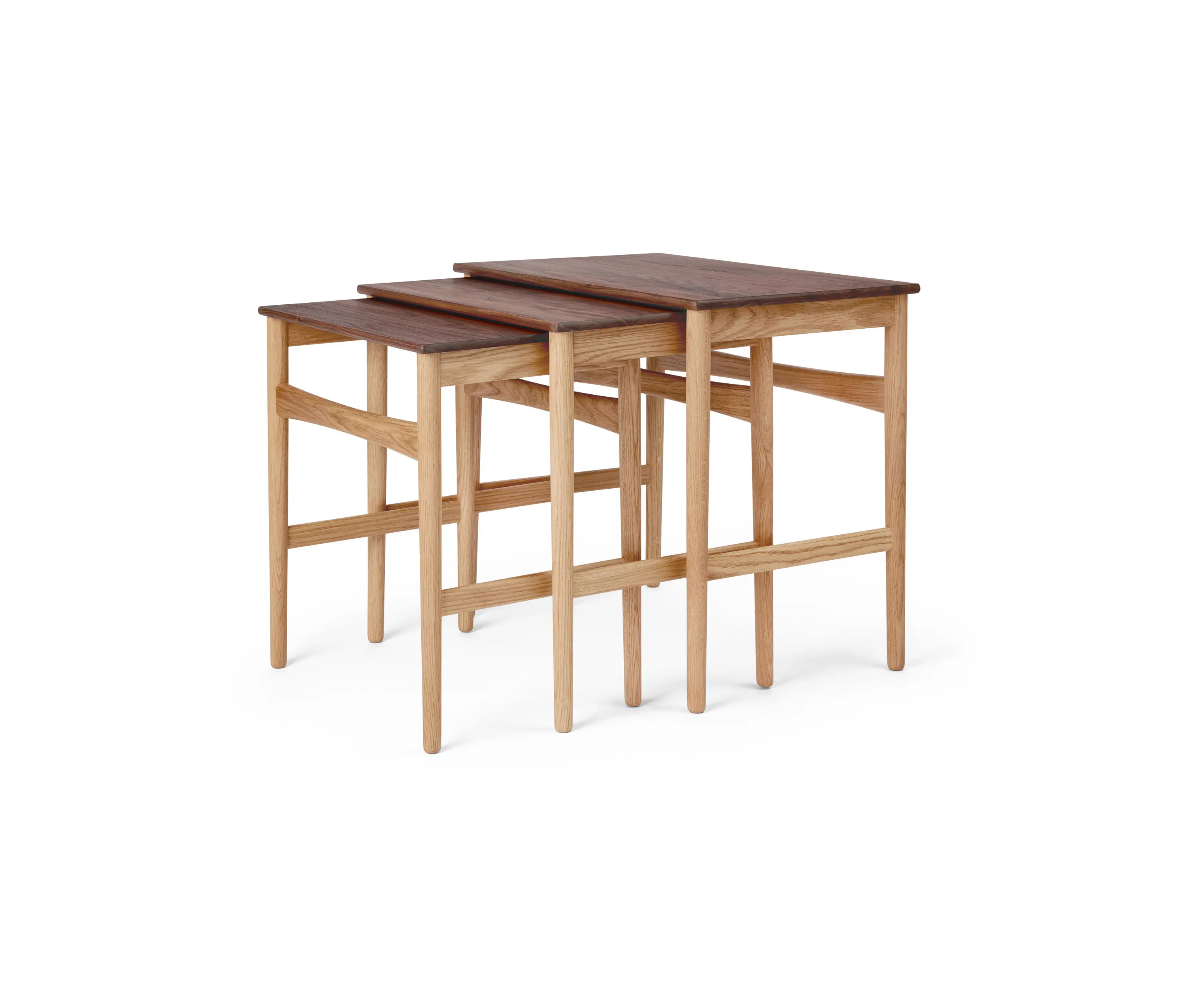
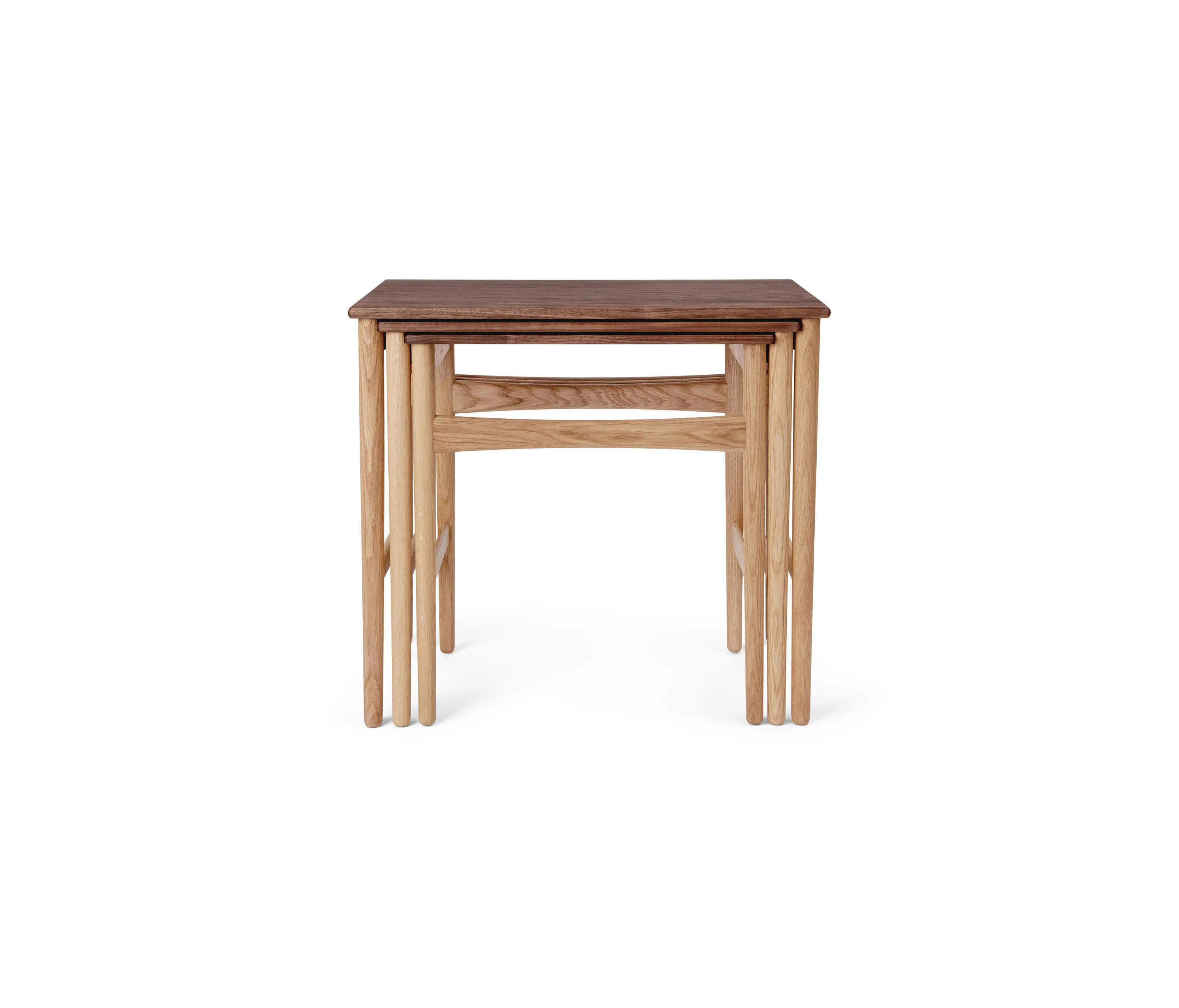
Hans J. Wegner’s iconic Nesting Tables were first launched in 1952. Due to their lightness, space-optimised design and classic Wegner minimalism, the side tables go well with any interior. The Nesting Tables consist of three different-sized nesting tables that can be used individually or combined. Available in FSC™-certified oak or walnut, or in an oak/walnut mix.
Hans J. Wegner was known for designing exceptionally simple and functional items of furniture that enhanced any room through their harmonious and aesthetic dimensions and materials. The Nesting Tables are no exception. The three tables are graduated so they fit together perfectly and can easily be integrated with other furniture, either as side tables or smaller coffee tables. The Nesting Tables have distinct Wegner details such as the round, tapered legs, classic mortise joints and subtle curves on the front and rear struts that add an organic and timeless look.
Nesting tables became popular in the 1950s hand in hand with the growing need for more flexible interiors – a need which is just as relevant today. Wegner’s Nesting Tables have an air of lightness about them that makes it easy to reorganise the furniture and create smaller zones within a room.
oak/walnut, oil
Este producto pertenece a la colección:
Base madera maciza, Roble, Tablero madera maciza, Nogal, Madera
Puedes visitar la página del producto para estas variantes, ¡simplemente haz clic en ellas!

Denmark
Hans J Wegner was one of the world's most famous furniture designers in the 20th century, and one of the driving forces behind the rise and influence of Danish design. The Life of Hans J Wegner Hans J Wegner was born on 2 April, 1914, in Tønder, Denmark. His talent for wood carving was recognised early on, during his apprenticeship as a carpenter. He went on to study design and also architecture at what would later become the Royal Danish Academy of Fine Arts in Copenhagen, where he taught furniture design between 1946 and 1953. In 1940, he initiated a project to fit out the Town Hall of Aarhus, together with fellow architects Erik Moller and Arne Jacobsen. That same year, Wegner began collaborating with the master cabinetmaker Johannes Hansen. The Danish Museum of Art & Design first bought one of Wegner’s chairs in 1942; but his most popular chair was the 1949 Wishbone Chair which has been produced since 1950 by Carl Hansen & Son. In 1982, Hans J Wegner won the CF Hansen Medal for architecture, the highest award for the discipline in Denmark; and in 1997 he won the 8th International Design Award in Osaka. He was also awarded with an honorary doctorate from the Royal College of Art in London in 1997. Hans J Wegner’s design approach Hans J Wegner was one of the most creative and productive furniture designers of his time. He designed numerous chairs, living-room furniture, dining tables and other home furnishings. He was best known for his chairs however; and following his motto ‘a chair is a chair only if someone sits on it’, Wegner united form and function with his chairs, and brought Scandinavian design to the fore. Wegner was concerned not only with the appearance of a chair, but with its function – to support the human body. Hans J Wegner's creativity and his extraordinary sense for sculptural expression made him the pioneer of Danish modernism. His approach to minimalism was inspired by the material properties of wood, and the sculptural, organic forms found in nature. For Wegner, the experience of a chair was not limited to the merely visual; it should be an artwork that appeals to all the senses, touch included. Hans J Wegner’s CH24 Wishbone Chair The CH24 Wishbone Chair, also known as the Y-Chair, is one of Hans J Wegner’s most successful designs. He created it for Carl Hansen & Son, who have produced it since the 1950s, as part of a series of chairs inspired by antique Chinese armchairs. The characteristic element that gives the chair its name is a Y-shaped, clavicle-like element supporting the backrest. The ergonomic design and strong, structural form of the Wishbone Chair have made it a design classic, and the chair became world famous when, in 1961, it was used during a TV debate between John F Kennedy and Richard Nixon. The CH25 Lounge Chair: a Danish design icon The CH25 Lounge Chair was one of the first chairs designed by Wegner for furniture manufacturer Carl Hansen & Son. The sloping rear legs give the CH25 Chair its characteristic appearance: restrained and yet structurally dynamic at the same time. The CH25 Lounge Chair was designed to be relaxing, while offering enough support so that the occupant would not fall asleep. Its strong form, and sculptural use of wood, is similar to that of the Wishbone Chair. © by Architonic