Share
1/7


The Spoke-back Sofa
Help me find it
About this product
Architonic ID: 1256459
SKU: 1789
Year of Launch: 1945
L: 160/197 cm, D: 76,5 cm, H: 86 cm, Sh: 40 cm
Concept
Børge Mogensen and Hans J. Wegner, both born in 1914, were both colleagues and friends, and the two Danish designers worked together on a number of exhibition projects. One of them was the annual Copenhagen Cabinetmaker’s Guild Exhibition in 1945, where Mogensen and Wegner designed and presented “A Home For the Future”.
The centrepiece of Mogensen and Wegner’s stand was the living room, in which they presented a new vision for lightweight and functional furniture. Even though the Spoke-back series was acclaimed for its innovation, it was also regarded as too sophisticated for the modest post-war culture, and the Spoke-back sofa did not go into production until 1963. In 1974 Wegner redesigned the 1788 easy chair to arrive at the current design.
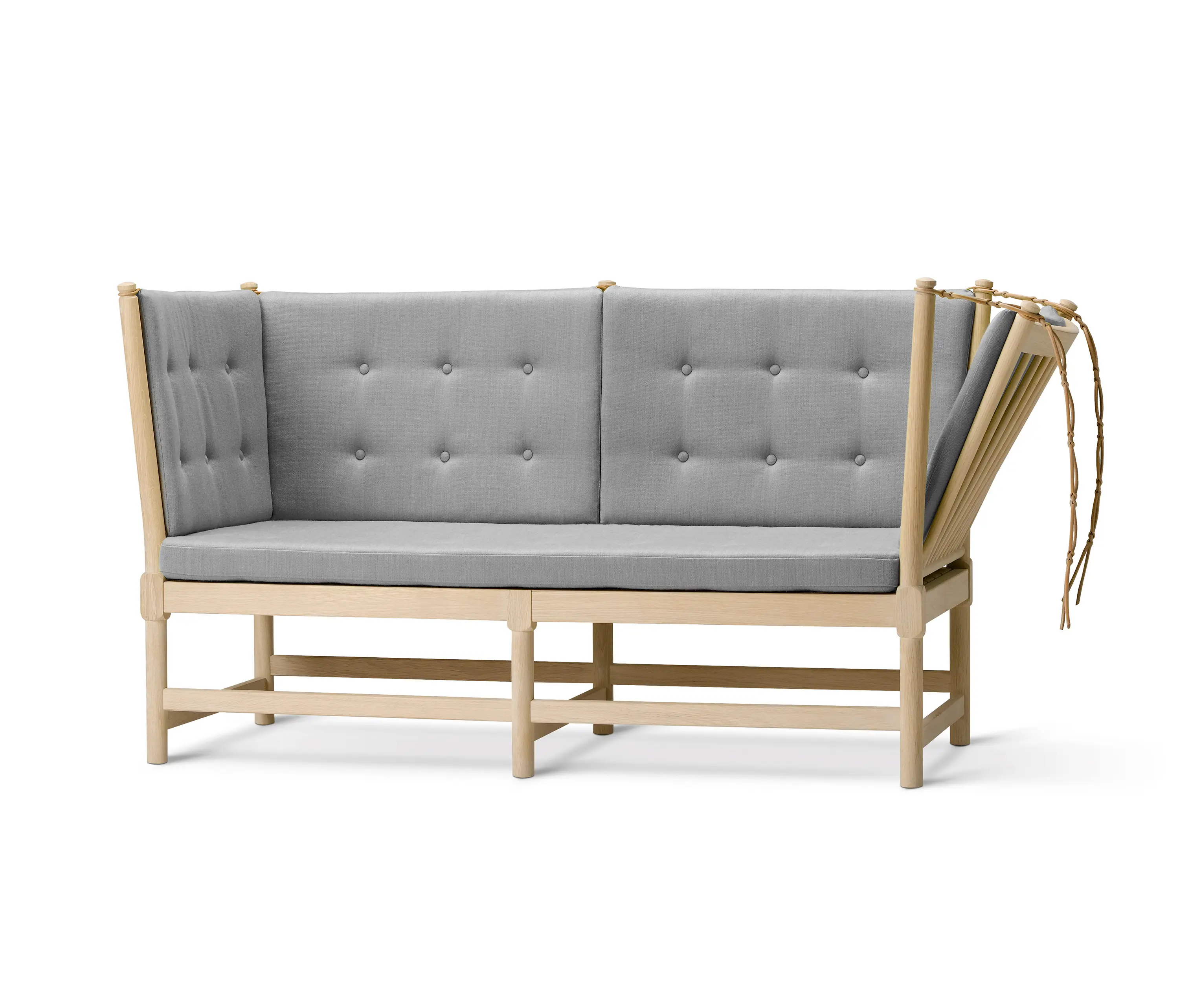
The Spoke-back Sofa materialises Mogensen’s idea of a sofa with a reclining side and it was originally exhibited without back cushions. Hans J. Wegner’s spoke-back chair provides a comfortable seat with beautiful profiling in the armrests that reveals Wegner’s sculptural talents.
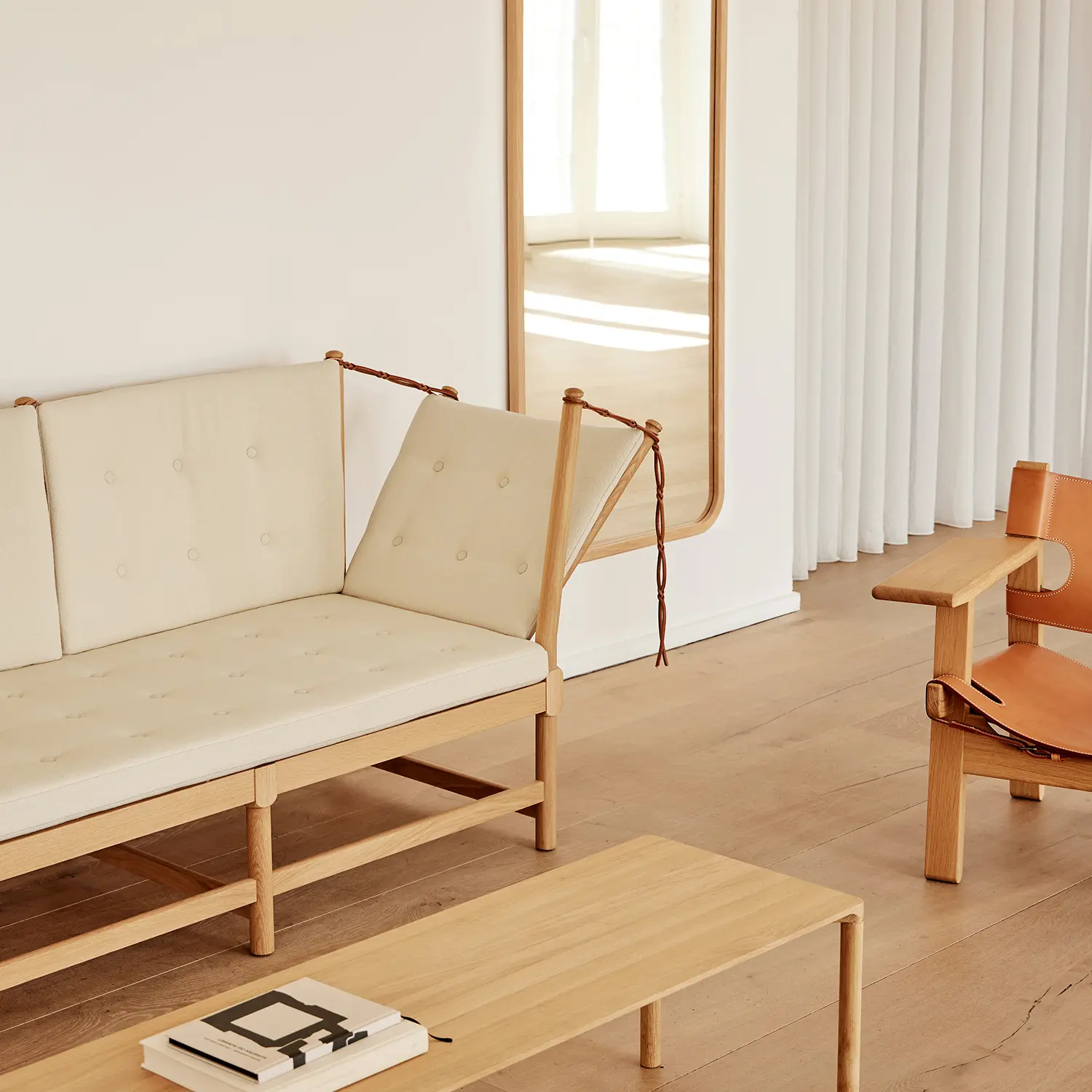
Both designs are completely bare from every angle – even the cushions are attached with visible straps. The exposed wooden construction is typical for both Mogensen and Wegner, and in the Spoke-back Collection they continued their work with the Windsor chair methodology.
This product belongs to collection:

Specifications
Material
Base solid wood, Wood
Design files
10
Distributors
Designers

Børge Mogensen
Denmark
Most people have heard of Børge Mogensen, a furniture designer whose collaboration with FDB, the Danish co-operative chain, enabled Danes to buy high-quality furniture at affordable prices. He went on to create some of the most widely recognised furniture classics of the 1950s and 1960s, a wide selection, in fact, thanks to his prolific productivity. Ideas came to Børge at all times of the day and night, and he noted them down on whatever was at hand: matchboxes, napkins or crumpled envelopes. For example, the Hunting Chair, destined to become one of Mogensen’s many classics, was sketched on a matchbox late at night in the company of good friends. We cannot say the name Børge Mogensen without also mentioning Andreas Graversen. Designer and manufacturer are always dependent on each other, but in this particular case, Andreas Graversen’s acquisition of Fredericia Furniture in 1955 marked the start of more than a purely professional partnership. Over the years, the two men developed a strong – and at times temperamental – friendship fuelled by a common desire to create simple, quality furniture with timeless aesthetic appeal. Before Mogensen’s untimely death in 1972, they jointly won the Furniture Prize in 1971 for their long-term collaboration, still appreciated today in private homes and public offices alike. 1934 Trained as a cabinet maker 1934-36 Worked as a joiner in Copenhagen and Aalborg 1938 Trained as a furniture designer at the School of Arts, Crafts and Design/Furniture School, Copenhagen, under Professor Kaare Klint, with whom he developed a close partnership 1942 Trained as an architect at the Royal Danish Academy of Fine Arts' School of Architecture 1938-43 Worked at various design studios in Copenhagen, including with Kaare Klint 1942-50 Manager of FDB’s furniture design studio, Copenhagen 1945 Awarded the Bissen Scholarship, Denmark 1945-47 Teaching assistant with Professor Kaare Klint at the Royal Danish Academy of Fine Arts' School of Architecture, Copenhagen 1950 Awarded the Eckersberg Medal, Denmark 1950-1972 Established own design studio, Copenhagen 1955 Partnership with FREDERICIA FURNITURE A/S begins 1971 Awarded the Furniture Prize, Denmark, in conjunction with FREDERICIA FURNITURE A/S Elected Honorary Royal Designer of Industry by the Royal Society of Arts, London 1972 Awarded the C.F. Hansen Medal, Denmark


