Share
1/11


pp75 | Stayed Table
Help me find it
- Home/Dining tables/
pp75 | Stayed Table
About this product
Architonic ID: 1002927
Year of Launch: 1982
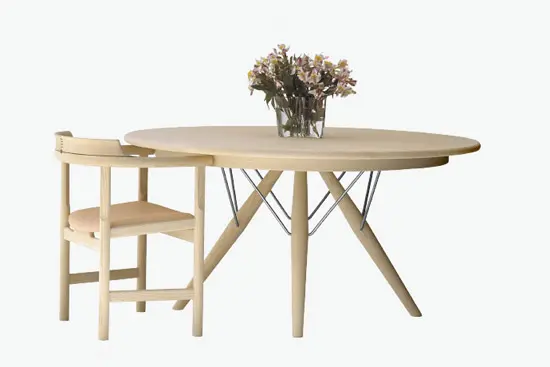
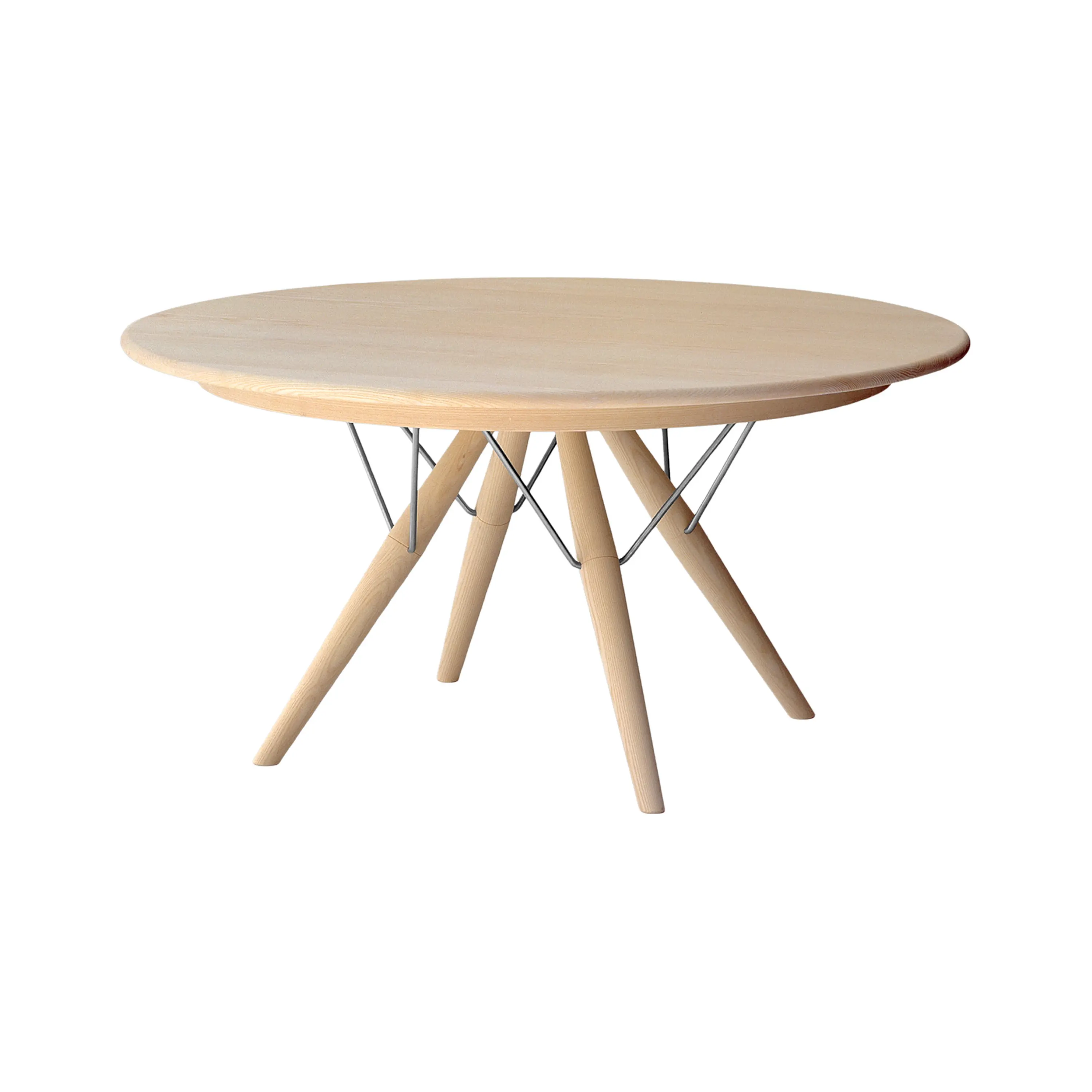
The pp75 Stayed Table is the result of an arduous design process, in which Wegner sought to maximise both the knee and legroom for those sitting at the table. To accomplish this, Wegner created a beautiful dining table with legs joined in the centre. He used geometric theory to support the solid wood tabletop with as little strain and as much space as possible.
Each leg is supported by steel stays that turn into strong triangular formations resulting in an elegant and strong construction.
As is commonly seen in Wegner’s best works; the pp75 Stayed Table combines practicality with a refined sense of aesthetics. The steel stays not only make the wood construction stand out, but also form the backbone for the table.
The durability of the construction allows the table to be extended by separating it at the middle and adding a wooden leaf in-between the extended parts.
Available in oak and ash.
Available in two standard sizes: 120cm and 140cm.
Concept
The table was designed by Hans J. Wegner in 1982 for PP Møbler. PP 75 is an exiting table from Wegner's hand. Especially noticeable is the frame, where we see Wegner's preoccupation with triangles.
The triangle is a simple and very strong construction principle, often used in larger constructions such as bridges, but with this design Wegner has made a quantum leap downwards in scale. The centrally placed legs constitute a pyramid in the shape of four triangles, and these triangles are repeated in the steel bars keeping the legs in place. Consequently, the circular, solid tabletop seems to balance itself on top of the pyramid.
In PP 75, construction principles, common sense, and strong symbolical symbols thus enter together in an almost metaphysical unity.
The table is available in soaptreated or lacquered ash or oak wood.
This product belongs to collection:

Specifications
Material
Base solid wood, Tabletop solid wood, Wood
Design files
3
Distributors
Designers

Hans J. Wegner
Denmark
Hans J Wegner was one of the world's most famous furniture designers in the 20th century, and one of the driving forces behind the rise and influence of Danish design. The Life of Hans J Wegner Hans J Wegner was born on 2 April, 1914, in Tønder, Denmark. His talent for wood carving was recognised early on, during his apprenticeship as a carpenter. He went on to study design and also architecture at what would later become the Royal Danish Academy of Fine Arts in Copenhagen, where he taught furniture design between 1946 and 1953. In 1940, he initiated a project to fit out the Town Hall of Aarhus, together with fellow architects Erik Moller and Arne Jacobsen. That same year, Wegner began collaborating with the master cabinetmaker Johannes Hansen. The Danish Museum of Art & Design first bought one of Wegner’s chairs in 1942; but his most popular chair was the 1949 Wishbone Chair which has been produced since 1950 by Carl Hansen & Son. In 1982, Hans J Wegner won the CF Hansen Medal for architecture, the highest award for the discipline in Denmark; and in 1997 he won the 8th International Design Award in Osaka. He was also awarded with an honorary doctorate from the Royal College of Art in London in 1997. Hans J Wegner’s design approach Hans J Wegner was one of the most creative and productive furniture designers of his time. He designed numerous chairs, living-room furniture, dining tables and other home furnishings. He was best known for his chairs however; and following his motto ‘a chair is a chair only if someone sits on it’, Wegner united form and function with his chairs, and brought Scandinavian design to the fore. Wegner was concerned not only with the appearance of a chair, but with its function – to support the human body. Hans J Wegner's creativity and his extraordinary sense for sculptural expression made him the pioneer of Danish modernism. His approach to minimalism was inspired by the material properties of wood, and the sculptural, organic forms found in nature. For Wegner, the experience of a chair was not limited to the merely visual; it should be an artwork that appeals to all the senses, touch included. Hans J Wegner’s CH24 Wishbone Chair The CH24 Wishbone Chair, also known as the Y-Chair, is one of Hans J Wegner’s most successful designs. He created it for Carl Hansen & Son, who have produced it since the 1950s, as part of a series of chairs inspired by antique Chinese armchairs. The characteristic element that gives the chair its name is a Y-shaped, clavicle-like element supporting the backrest. The ergonomic design and strong, structural form of the Wishbone Chair have made it a design classic, and the chair became world famous when, in 1961, it was used during a TV debate between John F Kennedy and Richard Nixon. The CH25 Lounge Chair: a Danish design icon The CH25 Lounge Chair was one of the first chairs designed by Wegner for furniture manufacturer Carl Hansen & Son. The sloping rear legs give the CH25 Chair its characteristic appearance: restrained and yet structurally dynamic at the same time. The CH25 Lounge Chair was designed to be relaxing, while offering enough support so that the occupant would not fall asleep. Its strong form, and sculptural use of wood, is similar to that of the Wishbone Chair. © by Architonic

