
Share

New
1/7
About this product
Architonic ID: 20799083
Year of Launch: 2025
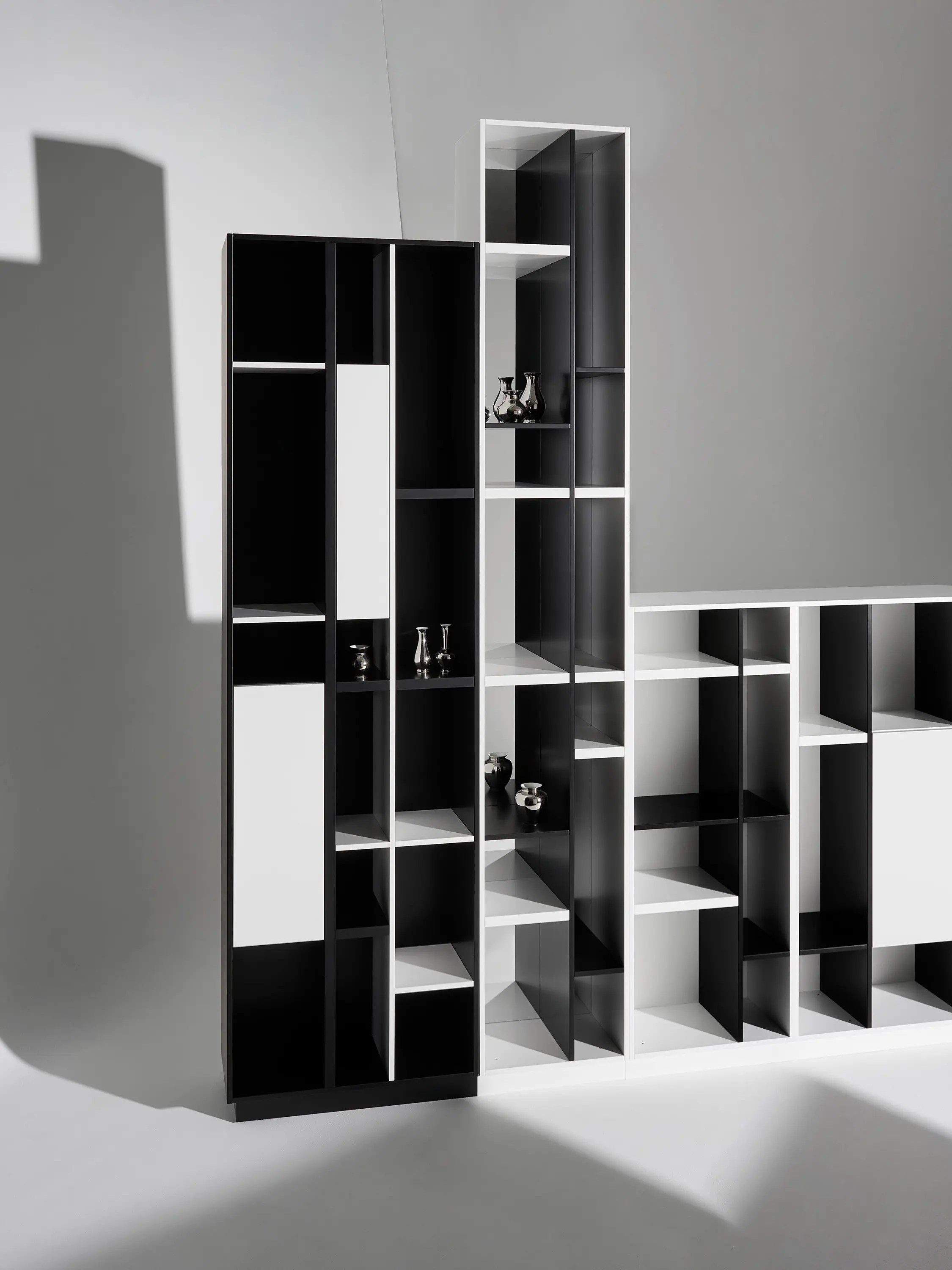
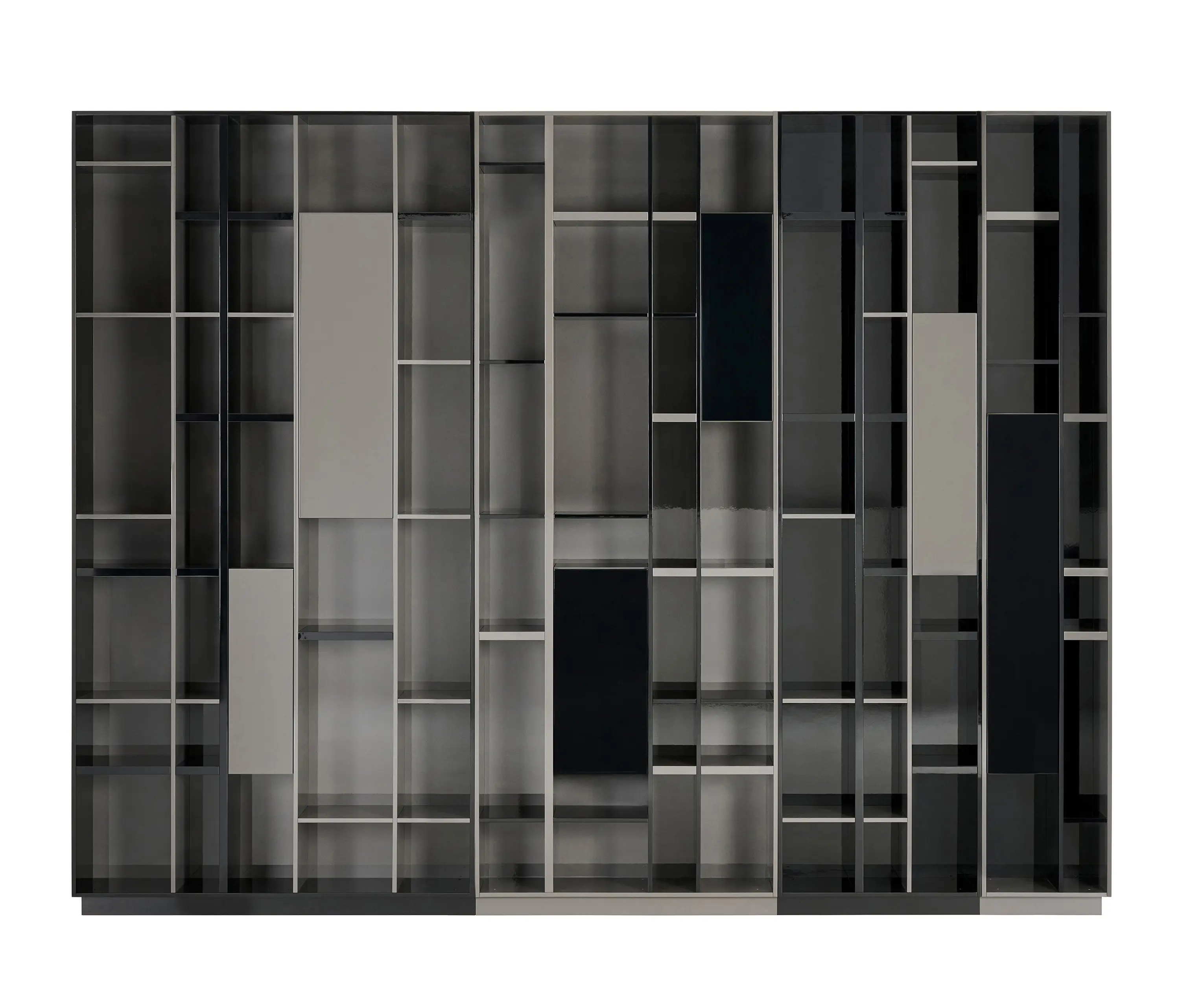
Shelving with a system: PLAID gets its appeal from its crisp, clear lines. Its individual elements can be freely combined and extended as desired, with no visible join between them. The trick, says designer Sebastian Herkner, is that “the horizontals and the verticals both come in two thicknesses, so when units are lined up one beside the other, two slim side walls look the same as one thicker one.”
The shelves are two different thicknesses and have fixed positions in the unit. So when two or more units stand side by side, they form a continuous line. PLAID can be configured with or without doors – which also come in fixed positions. The overall effect: “The shelving has a dynamic system to it, a bit like the tartan of a Scottish kilt,” says Herkner. On individual units, the plinth ends just before the side walls; when several units are combined, the plinth is continuous, bringing the individual units together to form a whole.
Available in four widths and five heights, PLAID can be perfectly integrated into any kind of space. It is made of fully lacquered MDF and comes in the full range of Schönbuch matt and high-gloss basic and accent colours.
In terms of colours, there is an array of options to suit all tastes. Certain elements – the sidewalls, top and bottom shelves, plinths and thick shelves – are always one colour while the rest can be finished in different shades. The rear wall can also be highlighted in a different colour – or
replaced with a mirror. “Combinations of two or three colours highlight the systematic nature of the design,” says Herkner.
“Shelving is a way of showcasing objects, books and things we love. It should provide a backdrop yet still have a character of its own.” Herkner’s vision is now a reality.
Finishes: fully lacquered, basic / accent colour or high-gloss colour
Back-wall: basic / accent colour, high-gloss colour or mirror
Shelf with or without doors
W 38,5 / 60,5 / 90 / 119,5 x H 120 / 150 / 180 / 210 / 240 x D 29 cm
Concept
PLAID shelving has a dynamic system to it, a bit like the tartan of a Scottish kilt. Its systematic nature is highlighted by combinations of two or three colours.
This product belongs to collection:

Specifications
Material
Engineered wood, MDF Medium Density Fiberboard, Structure engineered wood, Wood
Design files
11
Distributors
Designers

Studio Sebastian Herkner
Germany
Profile Sebastian Herkner was born in 1981 in Bad Mergentheim. He studied product design at the HfG Offenbach am Main (Offenbach University of Art and Design), already focusing during his studies on designing objects and furniture merging various cultural contexts, combining new technologies with traditional craftsmanship in order to highlight the multifaceted beauty of the materials and draw renewed attention to small details. Whilst still a student, Herkner did an internship with Stella McCartney in London, which helped to hone his feeling for materials, colours, structures and textures. Since founding his own design studio in Offenbach am Main in 2006, he has designed products for manufacturers such as ClassiCon, Dedon, Fontana Arte, La Chance, Moroso, Pulpo, Rosenthal and Very Wood, as well as working on interior design projects and for exhibitions and museums. Since 2007 he has taught several courses at HfG Offenbach am Main as visiting lecturer. His designs have received multiple prizes, for example the 2011 German Design Award in the Newcomer category, 2015 the EDIDA Award for Best International Newcomer and Guest of Honor at imm cologne 2016. // written by Markus Frenzl “There is a sensitivity and identity to my work that emphasizes the function, the material and the detail. I transport and interpret characteristics from various contexts of society and culture and implement them in new artifacts. This character infuses the most everyday objects with respect and personality. In this manner, seemingly contrary things can experience esteem.“ Sebastian Herkner, born 1981, studied Product Design at Offenbach Design Academy. During his studies he did an internship at Stella McCartney in London and developed a particular liking there for color, material and their connection. Since graduating from Offenbach in 2007 he has worked as assistant in the Product Design faculty and is in charge of projects in the realm of integrated design. As early as 2006 Sebastian Herkner established his own studio and has since then been involved in freelance projects for various companies and institutes. Alongside the design of exhibitions and trade fair presentations his second focus is on designing everyday objects. He is influenced in this by his observations of people and their actions. In this context it is important to look beyond your own disciplines in order to achieve a value-added for the user. Sebastian Herkner is not so much influenced by trends or current consumer criteria, because what interests him is a collage of simple techniques and traditional materials coupled with a simple mechanical principle and an unambiguous function. His idea of sustainability consists of employing traditional manufacturing techniques and their unique character. He then combines and interprets this by employing new technologies and finishing methods. In spring 2010 his occasional table Bell-Table was presented in New York in the collection of Spanish manufacturer ABR, which also received the red dot award 2010. // written by German Design Council Even at this early stage in his career Sebastian Herkner is attracting attention with his outstanding works. We can look forward to being surprised by more of his designs in the future. // Roland Heiler, Managing Director Porsche Design GmbH


