Share
1/12


Divide IT
Help me find it
- Home/Privacy screen/
Divide IT
About this product
Architonic ID: 20162425
Year of Launch: 2020
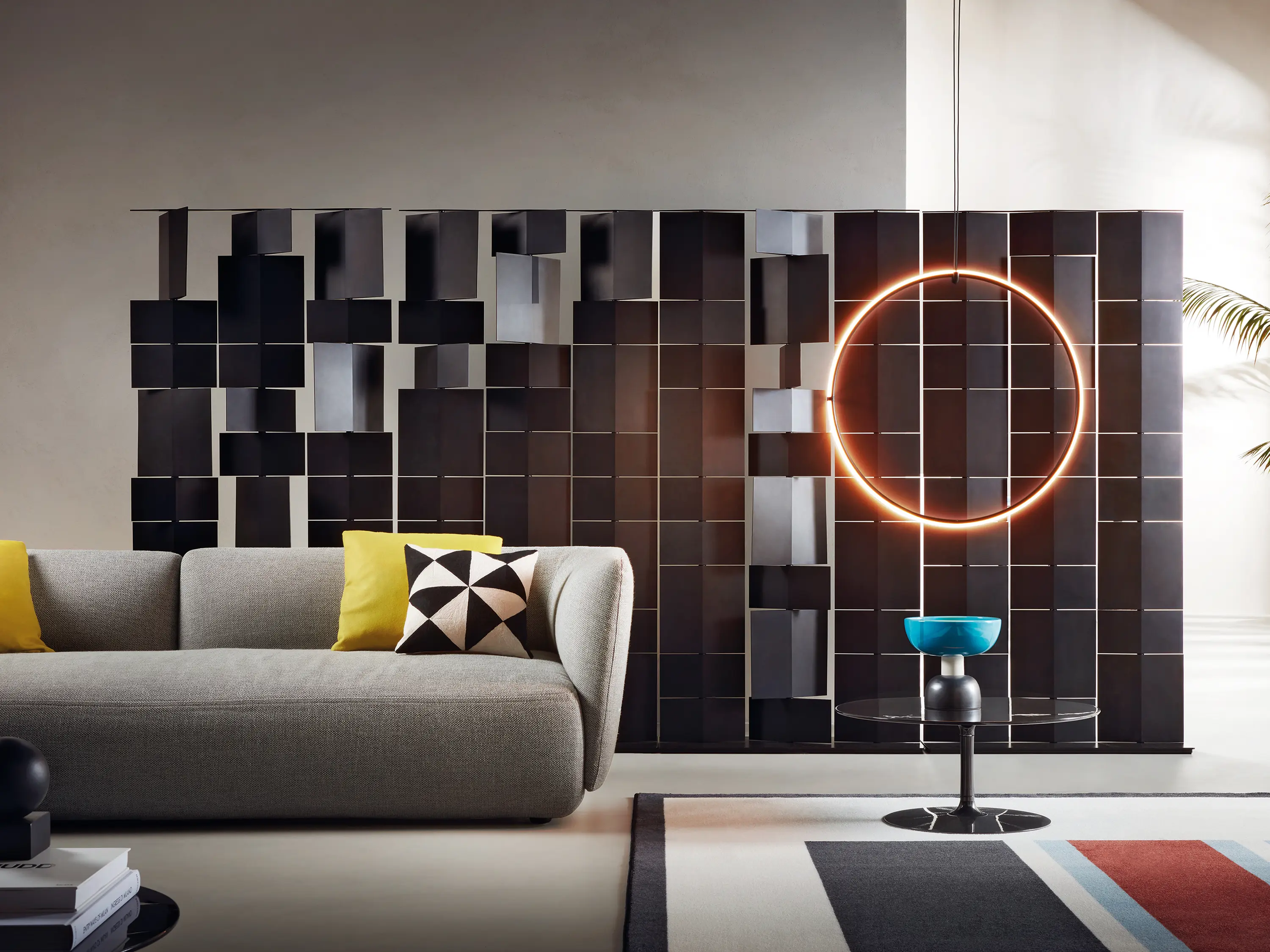
Divide IT was created to meet these needs: it is a dynamic product that adapts to every requirement and allows you to divide the work spaces and the home environment, to define unconstrained scenarios between work area and living, between semi-private and public areas; nowadays a precise, formal and traditional definition of the space is no longer relevant.
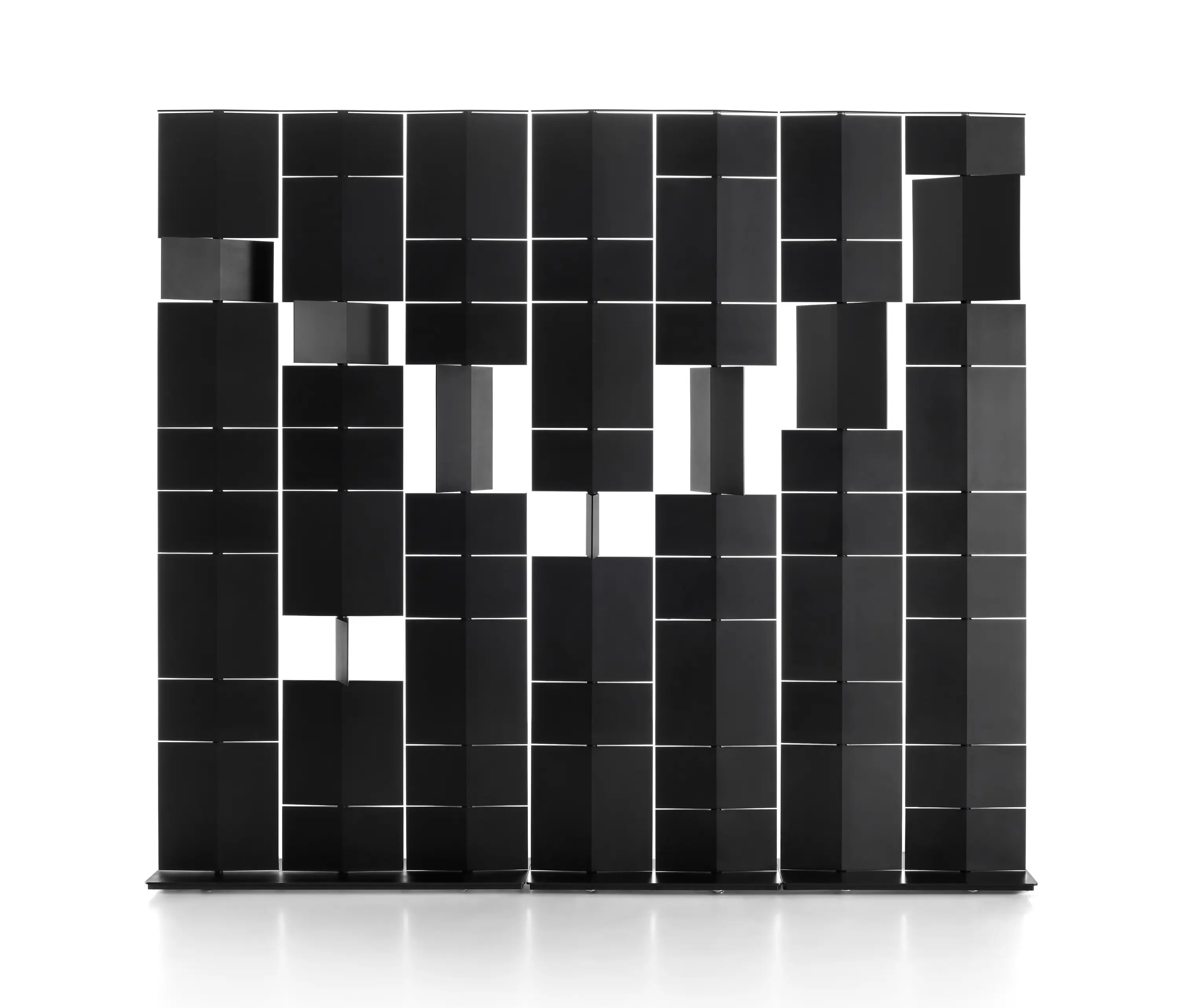
The user can determine and control the passage of light and sound with his own hands, rotating each panel on an axis at 360 degrees. This rotation allows for neverending possibilities of partition, transition and diffusion.
Divide IT invites the user to interact with it, as if it was a “toy” able to give fun and even a smile.
Structure
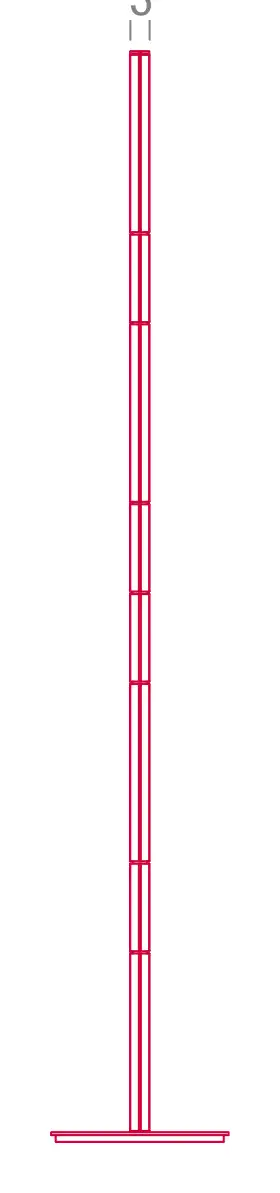
Load-bearing structure in aluminium sheet, bonded with metal anti-tilt weight, spherical steel castors (upon request) for easy 360° movement, uprights in steel, Ø 20 mm, with brake, and upper crosspiece in aluminium.
The entire structure is finished in matt white or black epoxy powder coating.
The swivel panels can be rotated by 360°.
Made in integral polyurethane painted in the mould, they come in two sizes, in the colours matt white and black, and are arranged in an alternated, defined geometric sequence.
Dimensions and types
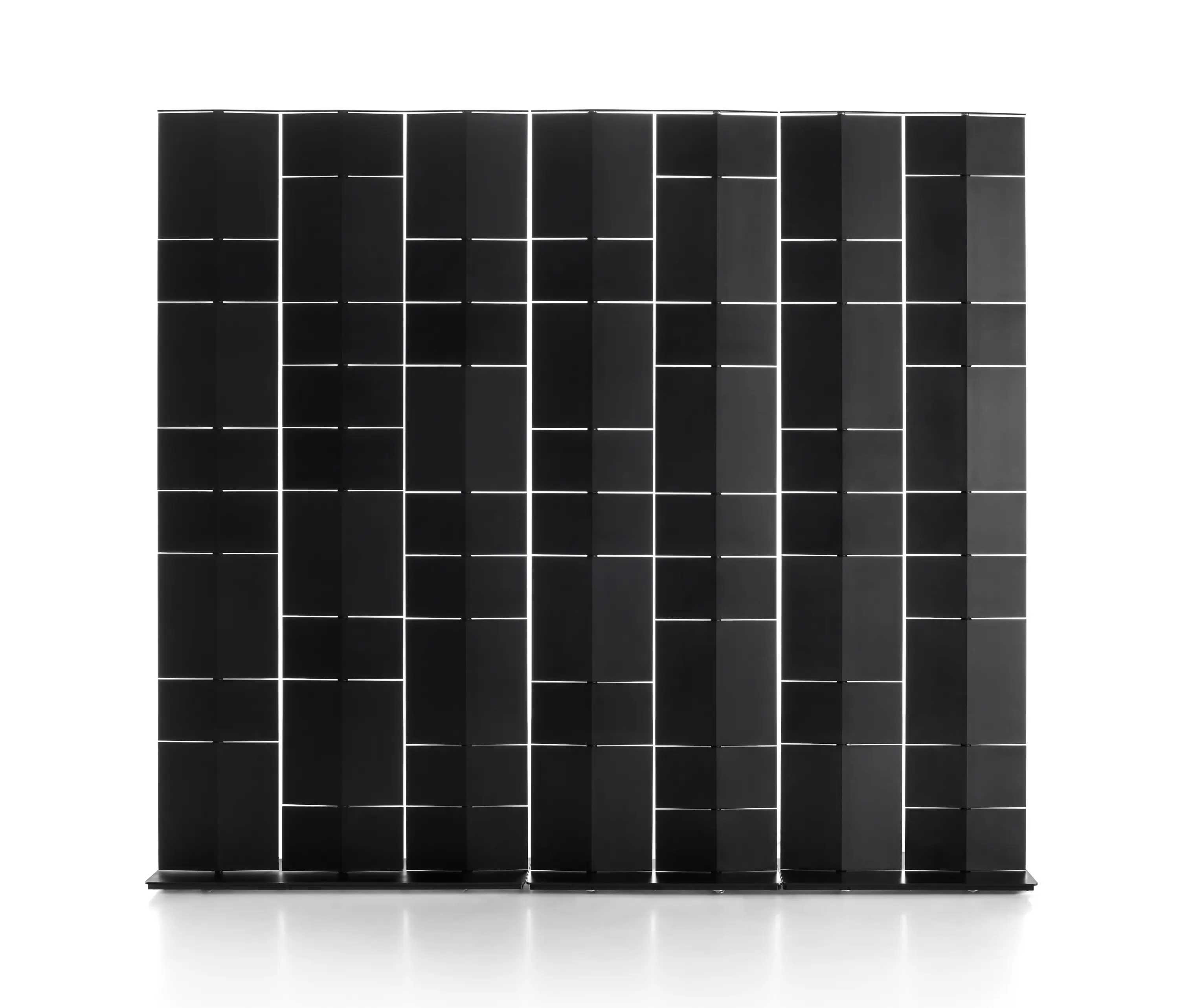
Each divider element is available in two different sizes, W90 and W60, (see sample compositions), which can be arranged or placed to form attractive large-sized configurations.
Divide IT is always monochromatic and available in the following combinations:
• matt white structure with matt white swivel panels;
• matt black structure with matt black swivel panels.
Accessories
The kit of castors is available only for hard floors (marbles, granite, terracotta, ceramics, gres, stone, concrete, et cetera).
Maintenance
For correct cleaning avoid alcohol-based products, use water and mild neutral soap. Rinse thoroughly after washing, only with water.
This product belongs to collection:

Specifications


Design files
22
Distributors
Designers

Pitsou Kedem Architects
Israel
Pitsou Kedem Architects Studio opened in 2000 and today consists of 11 architects. The studio is responsible for the design and planning of many projects in Israel and lately, also in Europe. Pitsou Kedem set up the studio after finishing his studies at the Architectural Association School of Architecture (AA). The studio’s design language and concept is founded on the modernist style and his work encompasses the values and principles of the period as well as the design philosophies of the modernist movement. During its formative years, the studio was involved in a constant dialogue with the fundamental principles of minimalism: reduction and moderation, clean lines for each element, separation of structural materials as part of the process designed to avoid the irrelevant in order to emphasize the significant and refining and seeking out the essence of the space. Together, all these elements lead to a strong architectural concept that is uncompromising in its search for the absolute truth, in its pursuit for purity of form and shape and in its goal of achieving a spatial perception of comfort and tranquility. This constant quest for simplicity leads to sophisticated and precise elements which , in turn, contributes to their uniqueness. The majority of the studio’s projects can be characterized by simple geometric, rectangular and recurring shapes that impart an exact and interconnecting look to the structure and its spaces. Structural facades are uniform, mono-chromatic, devoid of all decoration and provide a feeling of being almost monumental in nature. By using this architectural and design language, we attempt to bring order to urban chaos. For the past years, the studio has been searching for new materials, for a fresher approach that will allow us to enter new territory and step outside of recognized and boundaries. After years of simplifying materials to the extent avoiding all distractions that created those pure moments when “emptiness” disappeared and the individual sees and feels all that they failed to see and feel before, we began to add layers of materials and spatial layers. Inevitably, these layers created increasingly ambiguous and illusory spaces within the structure, layers that, in turn, created a greater sense of curiosity. A great deal of effort was used in our research for new materials, and in particular, for materials to be used for building external structures and walls. In its ongoing search to deepen and expand its architectural and design language and to add new contentment, the studio has, over the past few years, been working with contrasting materials such as weathered steel and exposed concrete on the one hand and carbon and other new and innovative materials taken from the world of industrial technology on the other. The combination of different materials and different architectural and design languages and even, on occasion, different schools of design, created, in many projects, a surprising and dramatic tension. The studio designs projects covering a wide range of sizes and complexity. From the interior design of restaurants, stores and living spaces to the design of private residences – usually those spreading over very large plots – and recently, hotels and residential complexes. In all of our projects we consult closely with the client and “brainstorm” in our efforts to discover the story, the concept, that flash of inspiration that will lead to the project’s design. The nucleus of an idea, leads to the development of the design language and concept which then leads to the development of spaces which serve the users – whilst all the time, placing an emphasis on the context and the integration of the building into the urban fabric. The studio has, over the years, been awarded many prizes including, for the past seven years, the Israeli Design Award. Our designs have been showcased in many professional journals and magazines around the world as well as on leading architectural web sites. Pitsou Kedem has mentored graduation projects for the Faculty of Architecture at the Technion, Israel and lectures regularly at all of Israel’s architectural faculties.


