





Contact details
Send a message
Call us
Distributors
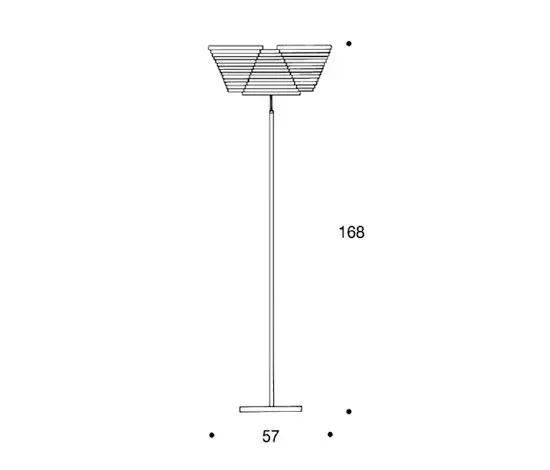
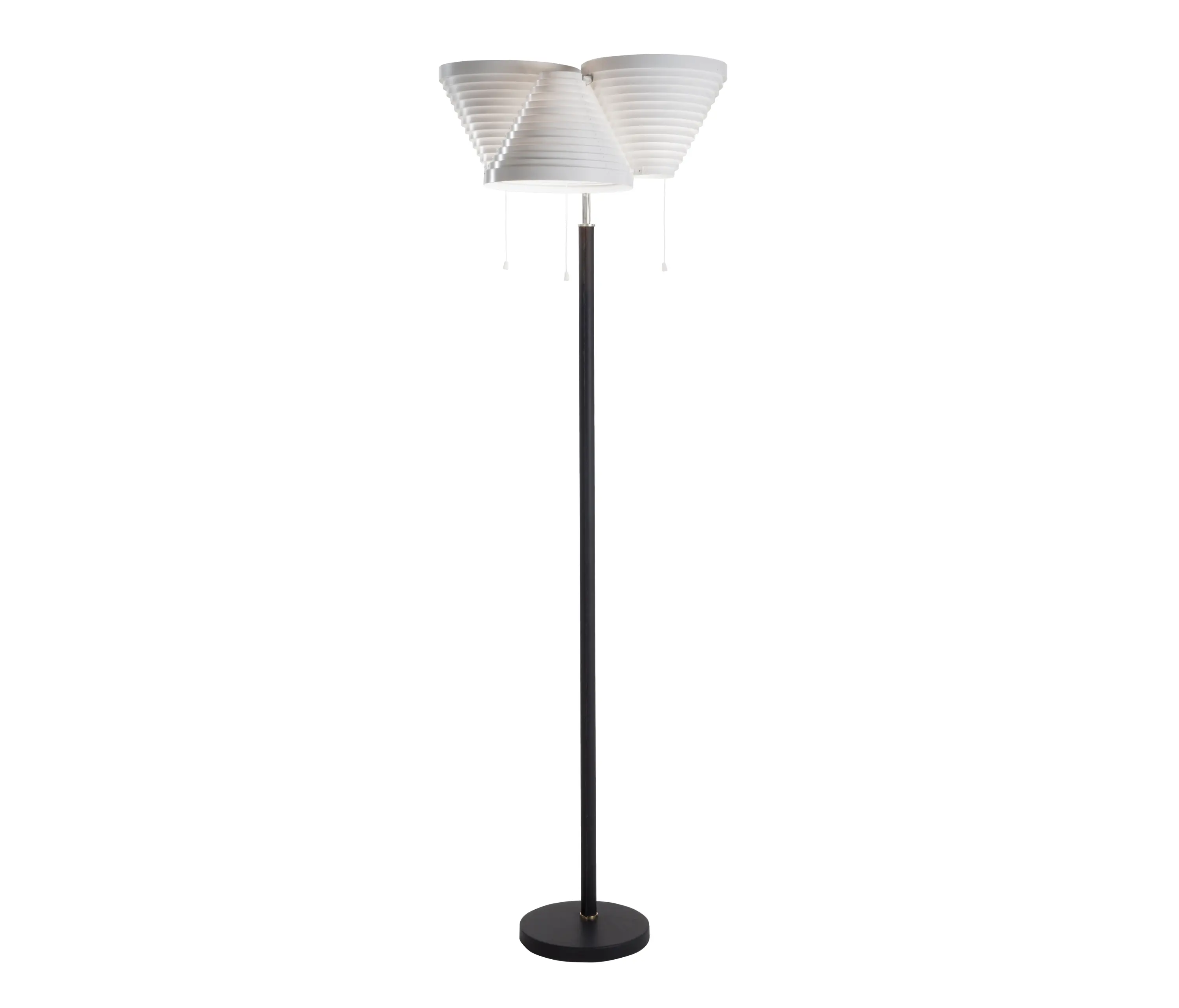
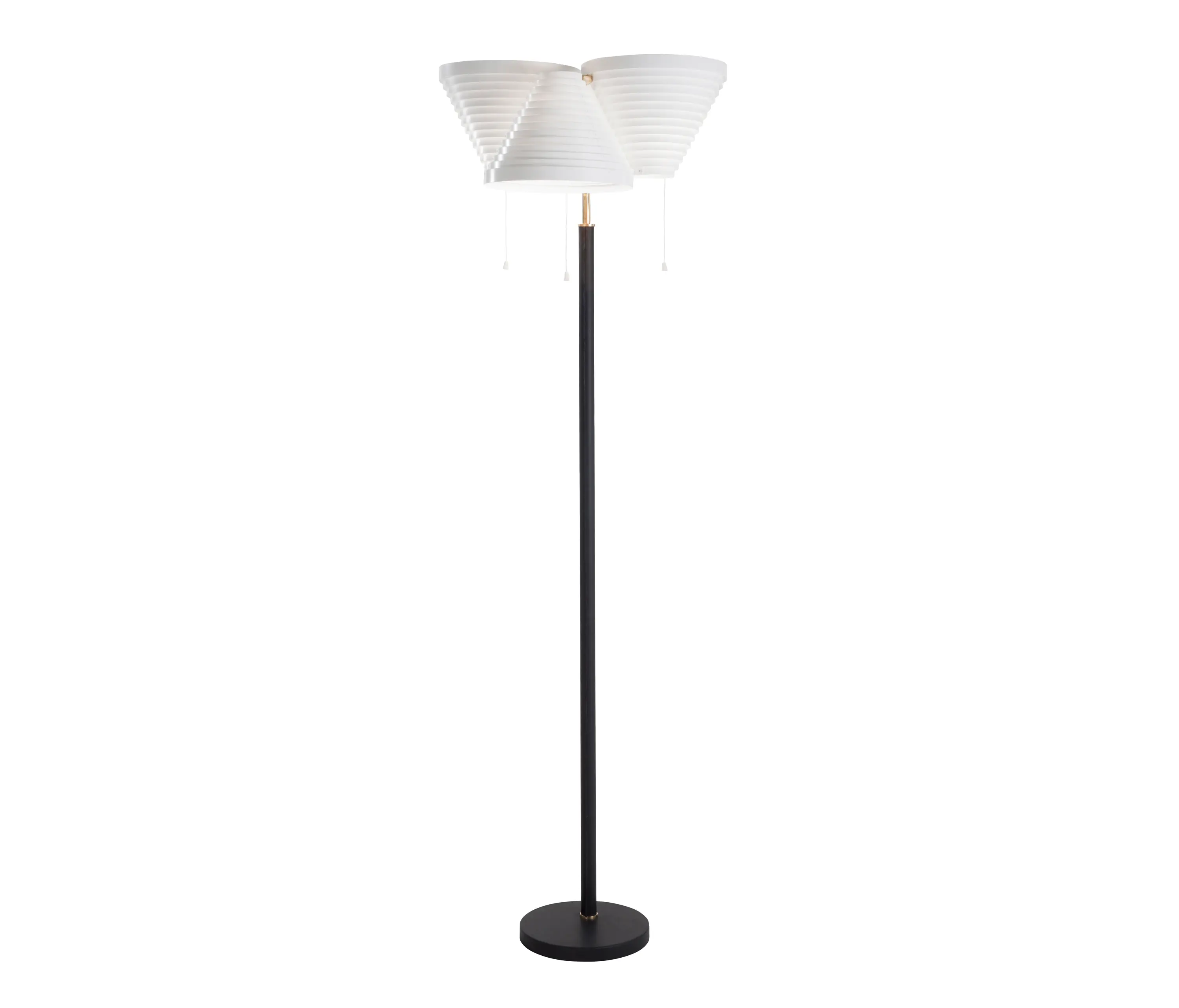
Floor Light A809
Architonic ID: 1010291
Year of Launch: 1959
This Floor Light features three hand-riveted shades, each formed from delicate, lacquered metal strips, which together present a striking combination of lines and curves. Floor Light A809 allows for different levels of brightness and the interplay of direct and indirect light. The stand is finished in hand-sewn black leather, while the neck has a polished brass collar. Floor Light A809 was created for the living room of the house near Paris designed by Alvar Aalto for French gallerist and collector Louis Carré in 1959.
Energy Class A- E;
Concept
For Alvar Aalto, the interplay of natural and artificial light was of central importance to his architecture, and he took great care in designing light fittings for his buildings. Sculptural in presence, beautiful as objects, Artek floor lights cast a light as characteristically diffuse as one would expect from the designs of Alvar Aalto.
All of Artek’s floor lights are manufactured in Finland.
This product belongs to collection:
Metal

Finland
Alvar Aalto was a Finnish architect, designer, sculptor and painter. He was considered one of the most influential architects of Nordic modernism and Finnish design in particular. Alvar Aalto: a biography Alvar Aalto was born on 3 February, 1898, in Kuortane, Finland. In 1921, he completed his architectural studies at the Technical University of Helsinki. By September of 1923, he had opened his first architectural office in Jyväskylä. It was only with the completion of his sanatorium in Paimio in 1932 that Aalto became internationally recognised. Later, buildings such as his library in Vyborg (1927–1935), his student residence in Cambridge, Massachusetts (1947–1949), the main building of the Helsinki University of Technology (1953), the Maison Carrée in Paris (1956–1958), the Cultural Centre in Wolfsburg (1958–1962) and the Essen Opera (1989) continued to build Aalto’s reputation for thoughtful modernist architectural designs. In 1935, Aalto and his wife Aino Aalto Marsio founded the furniture company Artek in Helsinki, together with Aalto’s patron, the industrialist's wife Mairea Gullichsen.From 1936, Aalto designed glassware for the company, including the now-iconic Aalto Vase. The Finnish manufacturer Iittala continues to produce the Aalto Vase to this day, while Artek continues to manufacture the Artek Stool and other Artek furniture. In the 1950s and 1960s, Aalto received numerous honours and awards for his achievements, including the Royal Gold Medal for Architecture, presented to him in 1957 by Queen Elizabeth II. The Savoy Vase by Alvar Aalto In 1936, Aalto created the Aalto Vase, together with the Finnish glass manufacturer Iittala. The Aalto vase became one of the most famous products of Finnish design. It was first designed for the luxurious Savoy Restaurant in Helsinki, from which it takes its other name, the Savoy Vase. With its asymmetrical shape and free-flowing curves, the design symbolises originality, straightforwardness and the high aesthetic standards that were innate to Finnish design. The vase is created from supple, wavy lines, which represent the Finnish landscape with its many lakes and forests. Aalto’s design for the vase was inspired by nature, much like his many architectural designs. The Aalto Vase was presented at the World Exhibition in Paris in 1937; and its simplicity has remained extremely popular, well into the 21st century. Smaller versions of the design are still produced in the Iittala glass factory in Finland. Recently, the vase has attained an iconic status. Alvar Aalto's Paimio Chair For his sanatorium project in Paimio, Alvar Aalto designed numerous pieces of furniture and lamps. The Paimio Chair was one of the Aalto furniture pieces designed for the interior of the building. Aalto worked with wood laminate to produce a warm, pliable material suitable for making furniture for patients who had to sit several hours at a time every day. The first drafts of the design for the Paimio Chair, or Paimio Armchair as it is sometimes called, were presented in 1929 in the city of Turku. Today, the Paimio Chair can be found in numerous museums, including in the permanent collection of the Museum of Modern Art in New York. © by Architonic