





Contact details
Send a message
Call us
Distributors
Change
Architonic ID: 1195310
Year of Launch: 2013
Concept
The path to classic design
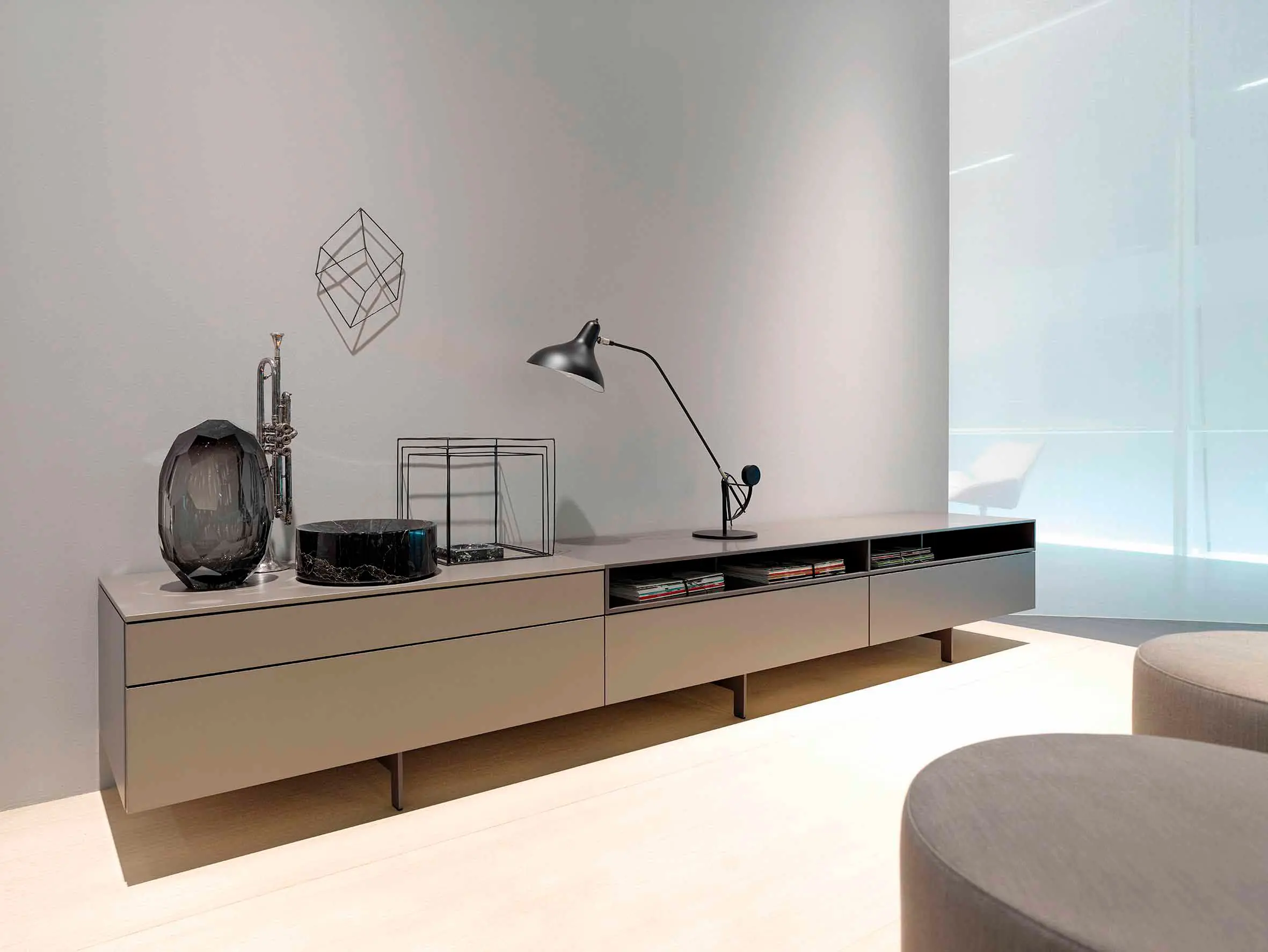
Sideboard, cabinet, solo cupboard, room divider or lowboard? cube, our fully customisable interior design concept, is for many good reasons already seen as a design classic. Continually developed since its launch in 2002, cube has evolved into an all-encompassing product range that includes cube gap, cube fine, cube change and cube play for extensible wall-mounted configurations.
Its impressive diversity, aesthetic and high-quality finishing establish cube as a universally usable and modern storage-space concept for every type of home and office. Depending on the configuration, and on the body design, surfaces and interior features selected, individualised units that exactly match the style their owner had in mind, in every detail and function, are created time and
again.
Behind this considerable design accomplishment there lies an equally ingenious but simple idea. cube consists of individual geometric modules of different heights, widths and depths in open or closed form that can be configured with doors, flaps or drawers.
Configured horizontally or vertically, these individual items can be arranged in (almost) endless ways. The diverse base modules can be configured side by side or even stacked, and can also be equipped with every useful feature, including media integration. The result is always astonishingly beautiful and surprisingly original.
cube change
fresh and flexible
Our cube change collection was developed for everyone who loves and wants to stay open to change. Consciously designed as a flexible furniture concept, it embodies the modern lifestyle that allows for changing viewpoints: cube change modules can be joined side by side or stacked, then separated again to be repositioned and rearranged in the room. The basic concept can also be extended with other elements: the perfect design for modern nomads even if it does not entail a move, but rather the new use of existing rooms and space. As with cube fine, change includes a variety of designs with push-to-open, handles and handle strips all available. Open and closed modules can be combined in different heights and widths and in different colours. Depending on how you want it to function, flexible interiors with ordering systems and various inserts can be designed, and TV panels can even be integrated.
This product belongs to collection:
Structure engineered wood, Wood

Germany
Profile The works of the designer Werner Aisslinger born 1964 cover the spectrum of experimental, artistic approaches, including industrial design and architecture. He delights in making use of the latest technologies and has helped introduce new materials and techniques to the world of product design like in his unique gel furniture with the collection“soft cell“ and the chaise „soft“ for zanotta in 2000. The "Juli chair (cappellini)" was the first item of furniture to use a new type of foam called "polyurethane integral foam" and became the first German chair design to be selected as a permanent exhibit at the MoMA in New York since 1964. In the process he has created striking designs and received awards from all over the world - from Milan's Compasso d'Oro to the Design Prize of the Federal Republic of Germany, the Red Dot Award or FX Award in the UK. Werner Aisslinger´s „loftcube“–project became one of the most discussed modular and transportable housing projects within the last years. His work is exhibited in the permanent collections of international museums such as the Museum of Modern Art (MoMA) and the Metropolitan Museum in New York, the French Fonds National d´Art Contemporain in Paris, the Museum Neue Sammlung in Munich, and the Vitra Design Museum in Weil, Germany. Werner Aisslinger lives and works in Berlin. Biography Werner Aisslinger, Designer / Interior Architect born 1964 in Nördlingen (Germany) 1986/87 University LMU Munich: history of arts and Science of Communication 1987-1992 Designstudent at University of fine Arts Berlin, Diploma 1989-1992 Freelancer at Jasper Morrison and Ron Arad, London and Studio de Lucchi in Milan 1993 Founding »studio aisslinger« in Berlin 1994-1997 Teaching at UdK Berlin and Lahti Design Institute, Finnland 1998-2005 Professor for Produktdesign at Staatlichen Hochschule für Gestaltung, Karlsruhe-Germany 2003 Founding Member of Association Transform-Berlin e.V. the Institution of the „Designmai“-Festival in Berlin 2006 projectmanager of Designlabor Bremerhafen, Germany since 2006 permanent Curator of Raymond Loewy Foundation as well as the Jury of the Lucky Strike Design Award. 2008-2009 Professor for Design at the Staatliche Hochschule für Gestaltung, Karlsruhe