


Share
1/7


Help me find it
About this product
Architonic ID: 1551069
SKU: 357
Year of Launch: 2018
Measurements:
high armchair, 73x66xh.45/130cm
low armchair 73x66xh.45/98cm
Materials: structure in wool felt, quilt coupled with polyester wadding
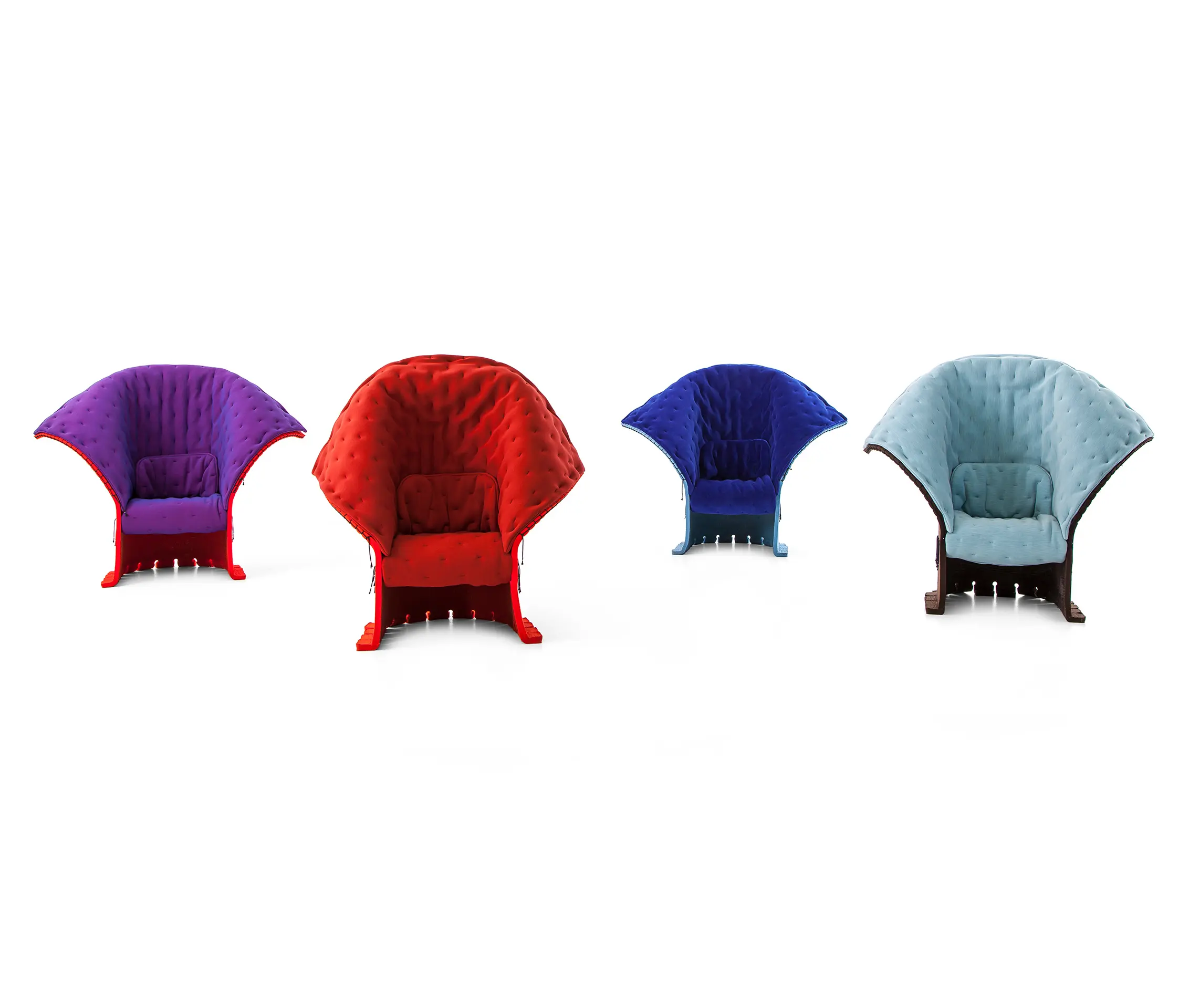
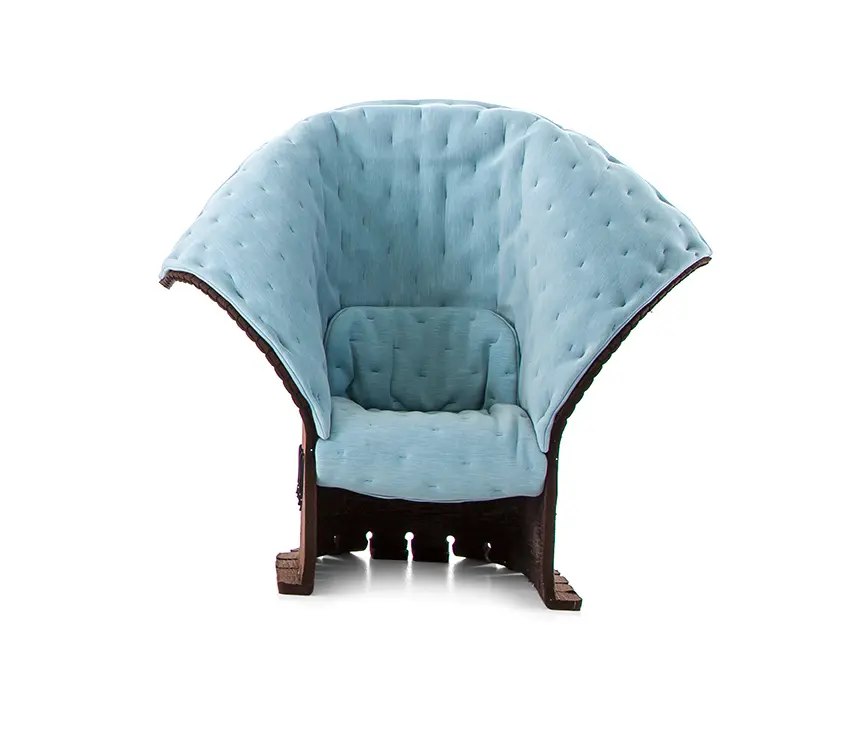
External finishes: plum, midnight blue, petrol blue, forest green, a grey melange and a pink melange, as well as the original black, red, brown and light blue versions Internal finishes: a wide range of new fabrics from the Cassina Collections.
Concept
The avant-garde becomes even more contemporary with the Feltri armchair. “The Feltri, the latest expression of innovative design from 1987, returns to the scene, still pleasingly youthful despite its advancing years thanks to a successful facelift carried out by Cassina’s expert surgeons."
Gaetano Pesce.
An established icon at just 30 years of age, now open to a broad and colourful new range of fabrics. The Feltri, an ironic take on a royal throne, is the result of figurative research carried out in a hybrid area between art and functionality. Despite its tender age, the armchair is already a mainstay of the websites of modern art and collectors’ items. It is a unique work, a very dear theme to Pesce, for its malleability and, above all, thanks to the possibility to combine a wide new range of fabrics for the quilt with six new colours for its felt structure (plum, midnight blue, petrol blue, forest green, a grey melange and a pink melange), making it more contemporary than ever. Industrial experimentation and the desire to explore materials. As a boy Gaetano Pesce spent a lot of his time at the Cassina Research & Development Centre. Many innovations emerged from this hive of experimentation, including the Feltri armchair. An armchair made entirely from thick wool felt, the backrest is soft and enveloping while the lower part, impregnated with thermosetting resin, is rigid and durable. A comfortable quilt in fabric coupled with polyester wadding lines the inside of the armchair to create a welcoming cocoon. Created using a patented production technique, the Feltri armchair is still today a symbol of cuttingedge
design.
This product belongs to collection:

Specifications
Material
Felt, Natural materials, Seat natural materials, Textile
Variants
4
You can visit the product page for these variants—just click on them!


Design files
35
Distributors
Designers

Gaetano Pesce
Italy
During his career, that spans four decades with commissions in architecture, urban planning, interior, exhibition and industrial design, Gaetano Pesce, the architect and designer, has conceived public and private projects in the United States, Europe, Latin America and Asia. In all his work, he expresses his guiding principle: that modernism is less a style than a method for interpreting the present and hinting at the future in which individuality is preserved and celebrated. Born in La Spezia, Italy, in 1939, Pesce studied Architecture at the University of Venice between 1958 to 1963 and was a participant in Gruppo N, an early collective concerned with programmed art patterned after the Bauhaus. He taught architecture at the Institut d’Architecture et d’Etudes Urbaines in Strasbourg, France, for 28 years, at the Carnegie Mellon in Pittsburgh, at the Domus Academy in Milan, at the Polytechinc of Hong Kong, at the Architectural School of Sao Paulo and at the Cooper Union in New York City, where he has made his home since 1980, after living in Venice, London, Helsinki and Paris. Pesce’s work is featured in over 30 permanent collections of the most important museums in the world, such as MoMa of New York and San Francisco, Metropolitan Museum in New York, Vitra Museum in Germany, Victoria and Albert Museum in London, Pompidou Center and Musee des Arts Décoratifs of Louvre in Paris; he exhibits art in galleries world wide. His award winning designs include the prestigious Chrysler Award for Innovation and Design in 1993, the Architektur and Wohnen Designer of the Year in 2006 and the Lawrence J. Israel Prize from the Fashion Institute of Technology in New York in 2009. Pesce experience has been global, his innovations consistently groundbreaking. Boundaries between art, design and industry are irrelevant to him, as art is most certainly not something created and put on a pedestal: art is a product, it is our creative response to the needs of the time we live in.


