Teilen

1/4


cloud softlight | mobile luminaires
- Startseite/Pendelleuchten/
cloud softlight | mobile luminaires
Über dieses Produkt
Architonic ID: 1212693
Einführungsjahr: 2011
cloud softlight | mobile luminaires
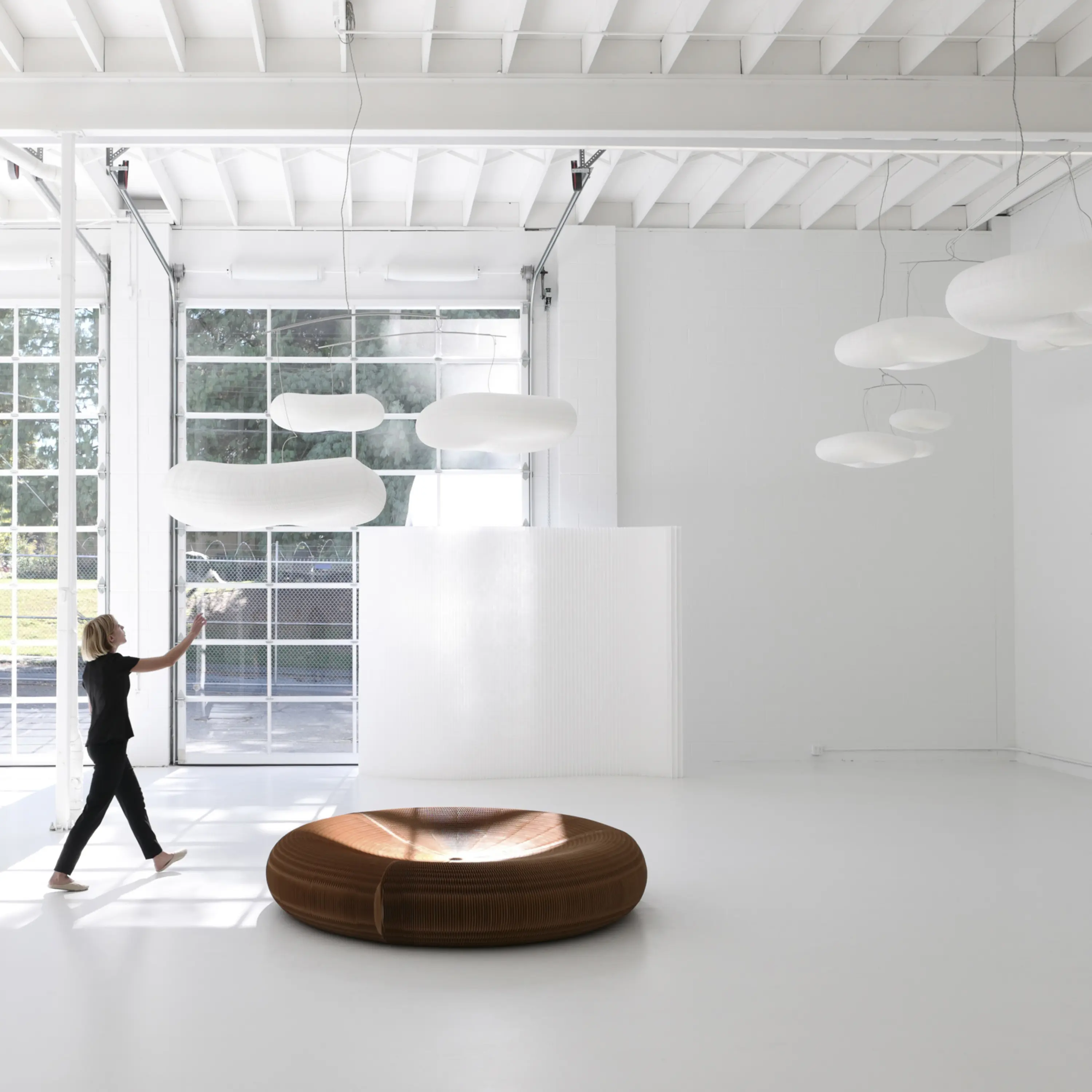
Inspired by Alexander Calder’s marvellous kinetic sculptures, cloud softlight mobile paper lamp redefines space through gentle movement and an intimate sense of enclosure. Each cloud pendant attaches to the mobile structure by a single point, softly bobbing and revolving with shifting air currents.
The paper lamp shades are lit from within by 90+ CRI LEDs to give a natural colour to all that they illuminate. When dimmed the cloud conjures a stormy, quietly dramatic atmosphere. At full brightness, the luminaries provide gentle light that is perfect to work, read, eat and live by. The honeycomb structure of cloud softlight acts as acoustic panels, floating overhead and absorbing sound, subduing reflected noise within a space.
Design by Stephanie Forsythe and Todd MacAllen
colour temperature:
Colour temperature is a scale that measures how ‘warm’ (yellow) or ‘cool’ (blue) the light from a particular source is.
cloud softlight collection colour temperatures: 4000K · neutral daylight white 3000K · warm white 2700K · warmer white
4000K mimics mid-day daylight, making it perfect for the spaces we occupy during the day. It helps to promote awareness and productivity in offices and other work environments.
The warmth of 2700 – 3000K is suited to spaces that we wind down in at the end of the day and evening, such as bedrooms, living rooms and restaurants.
90+ CRI
Colour Rendering Index (CRI) measures the ability of a human-made light source to reproduce the colours of the object it illuminates accurately. With a maximum score of 100, CRI values that are 90 and above are considered excellent, while scores below 80 are generally considered poor. CRI is measured in relation to the colour temperature of the light source and its equivalent daylight spectrum. All molo lighting, including the cloud softlight collection, is made with 90+ CRI LEDs.
With no visible hot spots, cloud softlight transmits a gentle, dimmable light in all directions.
material:
The translucent white shades of cloud softlight have a visually delicate appearance reminiscent of Japanese washi paper, and the pattern of its fine translucent fibres comes to life when illuminated. The shades are made from recyclable, non-woven polyethylene (HDPE). This non-woven textile is anti-static (repels dust), tear-resistant and water-resistant. Made to order for molo, our textile is a bright white that has an impressive colour consistency over time. It is easy to maintain, can be dusted and vacuumed, and, if necessary, can be wiped clean with a soft cloth, water and liquid dish soap.
acoustics:
A lighting fixture that absorbs sound and reduces the reflected noise in a room, cloud luminaires are an elegant way to float acoustic panels overhead.
cloud softlight has a Noise Reduction Coefficient (NRC) rating of 0.45, meaning that it absorbs 45% of the sound that it comes in contact with. Making cloud softlight an excellent way to improve the clarity of speech and provide an acoustically calm room.
plug-in / hardwire:
Choose between plug-in or hardwire installation. Plug-in cloud mobiles plug into a standard wall outlet and work internationally with 100 – 240 VAC. Plug-in mobiles do not have an inline dimmer. Select pendants if you would like a dimmable plug-in cloud.
Hardwire type also works internationally and requires a qualified electrician to connect cloud directly to a building’s electrical wiring. Hardwire cloud comes with a remote driver that is compatible with 0 – 10V Dimming systems. DALI-compatible drivers available on request.
immersive environments:
Pairing cloud with textile softwall or softseating creates cohesive arrangements that reach from ground to sky.
Dieses Produkt gehört zur Kollektion:

Produktdetails
Material
Kunststoff, Synthetische Faser, Textil
Design-Dateien
26
Designer

Stephanie Forsythe
Canada
Stephanie Forsythe and Todd MacAllen cofounded molo in 2003 and are best known for sharing their ideas and products for flexible, sustainable spacemaking around the world. Over the past three decades, the partners have worked together and led the Vancouver-based studio from humble beginnings to international recognition and acclaim. Along the way, they have assembled a dedicated team and a family of specialized manufacturers that support them in this endeavour. The partners work together to design all of molo’s products and projects, which range in size from a tea set to a museum. Forsythe and MacAllen met in 1994 while studying Architecture at Dalhousie University. Between 1994 and 2003, they worked together on several award-winning architectural projects and competition proposals. These projects included foundational investigations into materials, flexibility, and sustainable space making. The partners built molo around these early explorations and ideas, and they continue to drive the spirit behind the studio. Together, they designed and developed the iconic soft collection, a sculptural line of innovative, flexible space partitions, furniture, and lighting elements made from paper and textile. The award-winning soft collection is well known for its poetic beauty and pragmatic design. It experiences steady, iterative development as Stephanie Forsythe and Todd MacAllen continue their experiential and technical investigations, or as a sensitivity to nature and how the products interact with light and shadow inspires new finishes or colours. Stephanie Forsythe, Todd MacAllen, and molo hold over thirty-five patents and thirty design registrations. They have received numerous international design and architecture awards, including the prestigious Danish INDEX Award for Design to Improve Life for softwall, the Architectural Review AR + D Award for Colorado House, 2010 Emerging Voices Award from The Architectural League of New York and Grand Prize in the Aomori Northern Housing Competition. Their products have been acquired by many museum and gallery collections, including the New York Museum of Modern Art (MoMA), the Chicago Art Institute, Die Neue Sammlung, and the Cooper Hewitt Smithsonian Design Museum.

Todd MacAllen
Canada
Stephanie Forsythe and Todd MacAllen cofounded molo in 2003 and are best known for sharing their ideas and products for flexible, sustainable spacemaking around the world. Over the past three decades, the partners have worked together and led the Vancouver-based studio from humble beginnings to international recognition and acclaim. Along the way, they have assembled a dedicated team and a family of specialized manufacturers that support them in this endeavour. The partners work together to design all of molo’s products and projects, which range in size from a tea set to a museum. Forsythe and MacAllen met in 1994 while studying Architecture at Dalhousie University. Between 1994 and 2003, they worked together on several award-winning architectural projects and competition proposals. These projects included foundational investigations into materials, flexibility, and sustainable space making. The partners built molo around these early explorations and ideas, and they continue to drive the spirit behind the studio. Together, they designed and developed the iconic soft collection, a sculptural line of innovative, flexible space partitions, furniture, and lighting elements made from paper and textile. The award-winning soft collection is well known for its poetic beauty and pragmatic design. It experiences steady, iterative development as Stephanie Forsythe and Todd MacAllen continue their experiential and technical investigations, or as a sensitivity to nature and how the products interact with light and shadow inspires new finishes or colours. Stephanie Forsythe, Todd MacAllen, and molo hold over thirty-five patents and thirty design registrations. They have received numerous international design and architecture awards, including the prestigious Danish INDEX Award for Design to Improve Life for softwall, the Architectural Review AR + D Award for Colorado House, 2010 Emerging Voices Award from The Architectural League of New York and Grand Prize in the Aomori Northern Housing Competition. Their products have been acquired by many museum and gallery collections, including the New York Museum of Modern Art (MoMA), the Chicago Art Institute, Die Neue Sammlung, and the Cooper Hewitt Smithsonian Design Museum.


