Teilen
1/11

Modell A202
Teilen
Dieses Produkt ist nicht mehr erhältlich. Für Wartungsinformationen oder weitere Details wenden Sie sich bitte an
- Startseite/Couchtische/
Modell A202
Über dieses Produkt
Architonic ID: 1112060
Einführungsjahr: 1968
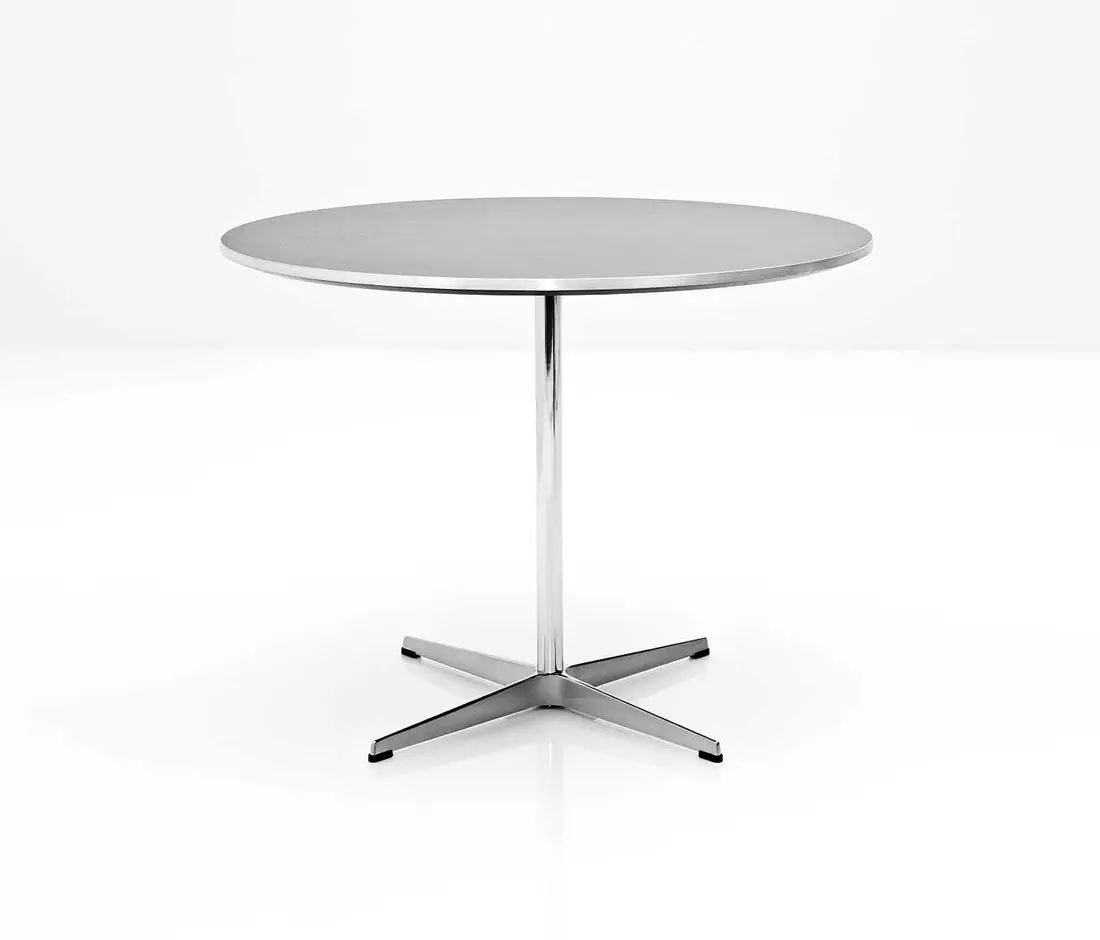
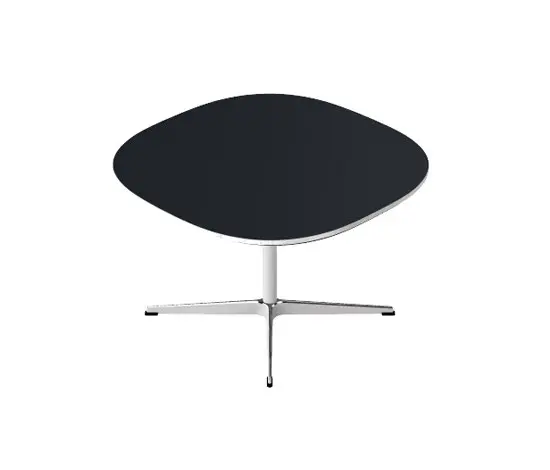
Couchtisch, Super-Zirkular, 4-armiger Säulenfuss
75 x 75 x H 47 cm
Konzept
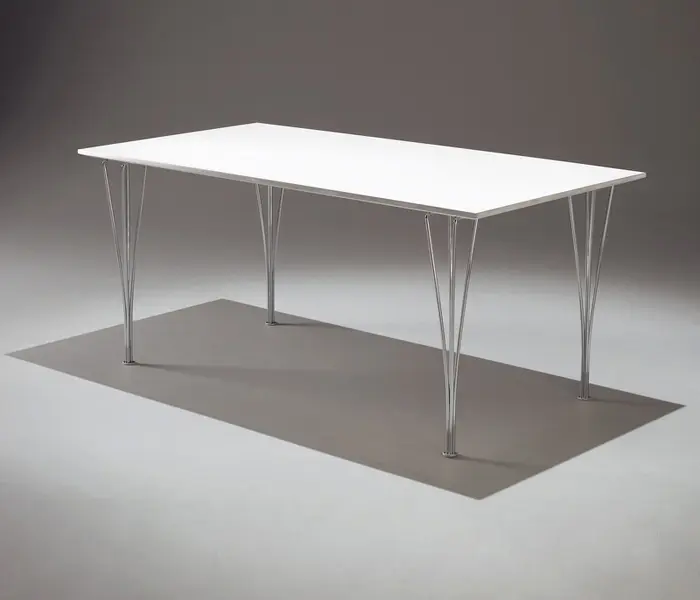
Zur Serie gehören von Piet Hein und Bruno Mathsson entworfene super-elliptische™, super-zirkulare™, zirkulare, quadratische und rechteckige Tische. Prominentester Vertreter der Serie ist der super-elliptische Tisch, angeregt durch die Lösung eines Verkehrsproblems, die der Designer Piet Hein für den Sergels Torg in Stockholm fand: Ein super-elliptischer Kreisel. Sein mathematischer Geist brachte diese geniale Gestalt hervor. Diese Variante eines Ovals besaß attraktive Eigenschaften und wirkte in allen Größen überraschend harmonisch. Die durch Formeln berechnete Gestalt, die keine Enden aufweist, macht den super-elliptischen Tisch zu einem demokratischen Tisch, an dem alle ebenbürtige Positionen einnehmen. Bruno Mathsson leistete einen Beitrag zum Gestelldesign aller Tische. Die Tische sind in vielfältigen Formen und Größen lieferbar. Mit ganz wenigen Ausnahmen sind alle Tische in drei Ausführungen erhältlich: Kunststoff, Furnier und Linoleum. Spannbeine aus verchromtem oder satinverchromtem Stahl.
Dieses Produkt gehört zur Kollektion:

Produktdetails
Material
Aluminium, Untergestell Metall, Verbundwerkstoff, Linoleum, Melamin, Metall, Kunststoff, Tischplatte beschichtet / laminiert, Tischplatte Holzwerkstoff, Tischplatte linoleum, Tischplatte Kunststoff, Holz
Design-Dateien
10
Vertriebspartner
Designer

Arne Jacobsen
Denmark
Arne Jacobsen wurde 1902 in Kopenhagen geboren. Zunächst begann er eine Lehre als Steinmetz. Wenig später wechselte er jedoch für sein Architekturstudium an die Königlich Dänische Kunstakademie Kopenhagen, welches er im Jahr 1927 beendete. Zu seinen ersten Projekten gehört das „Haus der Zukunft“ mit einem Helikopterlandeplatz auf dem Dach, das er gemeinsam mit Flemming Lassen entwarf. Es folgten Grossprojekte, wie die Bellavista-Siedlung in Klampenborg. 1942 gewann Arne Jacobsen zusammen mit Erik Moller den Architekturwettbewerb für das Rathaus von Arhus. 1952 realisierte er das SAS-Gebäude (Royal Hotel) in Kopenhagen. In diesem Rahmen entstanden seine Möbelstücke der Egg und Swan Chair, deren organische Formgebung sie schnell zu Designikonen werden liess. Neben seinen Architekturarbeiten war er ab 1956 als Professor an der Königlich Dänischen Kunstakademie tätig. Weitere wichtige Bauten, die zu den Pionierleistungen der skandinavischen Moderne vor dem 2. Weltkrieg zählen sind die Munkegårdsschule in Gentofte, Toms Fabrikker in Ballerup, Dänemarks Nationalbank und die Sportshalle in Landskrona. Internationale Projekte wie das Schulgebäude für das Hamburger Christianeum und die dänische Botschaft in London wurden erst nach seinem Tod fertiggestellt. Design Jacobsen entwarf Möbel, Textilien, Besteck, Tapeten und andere Objekte. Zu seinen bekanntesten Arbeiten zählen seine Stuhl-Serien. Der 1952 entworfene Stuhl Ant bzw. Ameise und der Serie 7 Stuhl gehören zu den kommerziell erfolgreichsten. Jacobsens Designs sind besonders von den Design-Ikonen Le Corbusier und Ludwig Mies van der Rohe beeinflusst. Er zeichnete sich durch sein Streben nach Perfektion aus: Wenn er gerade nicht arbeitete, arbeitete er trotzdem, nur eben an etwas Anderem. Entspannung bedeutete für ihn, sich einer anderen kreativen Beschäftigung zu widmen, weshalb Ergebnisse mit kompromisslos hoher Qualität entstanden. Sein Ziel, industriell gefertigte Objekte mit handgefertigter Qualität herzustellen, verlor er nie aus den Augen. Swan Chair Für die Lobby und Lounge Bereiche des SAS Royal Hotel gilt der Swan Chair (1956) bis heute als wahrer Meilenstein des Designs. Inspiriert von der Eleganz des Tieres zeichnet den Sessel eine innovative Konstruktion aus: Im Vergleich zu den damals üblichen geraden Formen präsentiert der Swan Chair sich in schwungvollen organischen Kurven und weichen Formen. Jacobsen stellt so deutlich den Bezug zu organischen Formen dar. Des Weiteren verkörpert der Sessel mit seinen kräftigen Farben das Lebensgefühl der 60er Jahre. Der Swan Chair wird bis heute vom Möbelhersteller Fritz Hansen produziert. Egg Chair Wie der Swan Chair entwarf Arne Jacobsen den Egg Chair (1956) im Rahmen seines Projektes für das Kopenhagener Royal Hotel. Er wurde aufgrund seiner Grösse für die Lobby und Lounges ausgewählt. Das Design weist eine ähnliche Formensprache wie der Swan Chair auf und verkörpert den modernen Funktionalismus. Die Form ist dementsprechend eher dezent und schlicht gehalten und erinnert an eine ovale Eierschale. Aufgrund seiner herausstechenden Konzeption gehört er heute zu den bekanntesten Designsesseln des 20. Jahrhunderts. © by Architonic

Piet Hein
Denmark
Piet Hein - the rational idealist Multi-thinker and universalist Life started rather conventionally for Piet Hein. His father and mother were an engineer and an ophthalmologist, respectively. Piet Hein's childhood and adolescence in Copenhagen ended with his obtaining a general certificate from the Metropolitan Grammar School, and subsequently he took the introductory course in philosophy at the University of Copenhagen in the autumn of 1924. Afterwards the life of the now 19 year old Piet Hein became anything but regular. For a time he left the university in order to attend private art schools in the capital, and he spent some time as a student at the Royal Swedish Academy of Fine Arts in Stockholm as well. He came back to Denmark and apparently he changed his course again studying philosophy and theoretical physics at the University of Copenhagen, at the Technological University and at Niels Bohr Institute. Perhaps this accounts for Piet Hein's fundamental distinction. For him there was no unbridgeable gap between the subjectivity of the fine arts and the objective world of science. Throughout life he grew and expressed himself both as an artist and a scientist. He has been called a universalist. In that way a spiritual affinity existed between him and the Renaissance ideal - a modern variant of Leonardo da Vinci. However, contrary to the historical ideals, in Piet Hein's works is found an easily recognizable element whether it is a matter of scientific publications, essays, poetry or architecture. The special Piet Hein touch is the superiority of the form in relation to the objectives, the medium and - for that matter - the contents. Piet Hein's world is almost the epitome of design. His recognisable style of language and material turns design into art. He belonged to the generation which also included some of the cultural leftists of the interwar years and later on those of the flower power generation, but he chose to go neither with nor against the current. Piet Hein chose his own course. The headlines of this course were only few, and they accompanied him in a poetic and architectural production for almost sixty years. Were his production to be collected under one single subject heading, the word harmony would probably be the most adequate. In 1944 Piet Hein explained his working method in this way :"Art is solution to problems which cannot be formulated clearly before they have been solved". Other people have very aptly called his working method architectural poetic design. Harmonic forming in words : Grooks Now and then in the 1930s the Danes might read some short poems by Piet Hein in the daily newspaper Politiken. They were printed under the headline "From day to day" and both the newspaper and the author saw them as poetic comments on small and great occurrences in everyday life. From 1940 the form grew more firm. Piet Hein's special grooks were created, the poet's alias being Kumbel Kumbell. Many people have tried to define what a grook actually is. It may be said that most grooks say what anybody may think out themselves, but they put pertinent new perspectives on everyday observations which present the reader with small instructions in the finest of all the arts: the art of living. Thus everybody recognizes themselves in Kumbel's universe. From 1940 to 1963 twenty volumes of original collections of grooks were published. One of the first grooks - "Taking fun as simply fun" - remained one of the most famous. Piet Hein called it pedagogical grook and mentioned it afterwards in other connections as a kind of key to all the other grooks. The poet Kumbel Kumbell had his poems translated into all kinds of different languages, more than one and a half million copies have been printed. The small grooks belong to everybody, exactly as was Piet Hein's original intention. They are meant to be used and the author did not hold back from taking part in initiatives which might result in further distribution. Small porcelain butter platters with a grook painted on them became famous. He was also responsible for translations of entire collections of grooks into English as well as Esperanto. Harmonic forming in mathematics: The superellipse Parallel to his poetic work, Piet Hein decided to find an absolutely harmonic physical design. With mathematical intuition he first found the form and then explained it afterwards. His superellipse was to solve the double contrast between the circle and the square and that of the ellipse and the rectangle. By means of mathematics he found a harmonic geometrical figure which was first used on a large scale in connection with the solution to a town planning problem in Stockholm. In a rectangular square, 200 metres long, in Stockholm's centre two motorways were to meet in a gigantic roundabout. The solution was the application of the superellipse to both square and roundabout at the new Sergels Torg. Later on the superellipse has been used in Canada, France, Japan, the US and Mexico in connection with the solution of as different constructions as residential areas and sports centres for example the Olympic Stadium in Mexico City. Within furniture design the superellipse also became the solution to various problems - especially in relation to Piet Hein's design of tabletops the superellipse became popular. In a three-dimensional version the superellipse became the superegg which has been used for metal versions of various board games, superegg drink coolers and the anti-stress ball. Especially the latter reached an enormous distribution in the 1970s. In addition to his work with the development of the superellipse Piet Hein has executed a great many other design commissions, from board games in wood to the elegant Sinus lamp. The belief in the intellectual man In 1940 Piet Hein became the president of the association Frisindet Kulturkamp (Liberal Cultural Action). This was the first visible step in his effort towards globalism and harmony. This effort is probably best illustrated by his presidency in 1948-1949 of the Danish branch of World Movement for World Federal Government. Here people were seriously working for the solution of the worlds’ overall problems and conflicts through idealistic scientific work on a world-wide basis which was to be achieved by bringing together intellectuals from all over the world. Later on for Piet Hein it became a question of propagating the international artificial language Esperanto and memberships of the committees of Open Door International, Humanistisk Forbund (Humanistic Union), Ligaen for Tolerance (The League for Tolerance) and for example International Pen. Furthermore, it was characteristic of Piet Hein that he deliberately sought the personal acquaintance of the intellectual elite of his time at international level. From his youth at the Technological University in Copenhagen he knew the physicist Niels Bohr. Through him Piet Hein also sought the acquaintance of Albert Einstein and Charles Chaplin after the Second World War. A close friendship developed between these people and in several essays Piet Hein has described how he was inspired by this. National and international recognition Piet Hein is among the Danes which have received the most awards in the twentieth century. In Denmark he has received the Aarestrup-medal ( 1969), the Industrial Design-prize (1971), the Storm Petersen-prize (1978), the Medal Ingenio et Arti (1985), the annual prize of Danish Design Council (1989) and the Tietgen Medal (1990) as well as honorary memberships of the Students' Association (1970), the Royal Copenhagen Shooting Society (1978), Det Danske Broderskab (the Danish Guild) (1978). Of international distinctions can be mentioned Alexander Graham Bell Silver Bell (1968), Die gute Industrieform (1971), Doctor of Human Letters at Yale University (1972), Huitième Salon Internationale du Lumiaire (1973) and Nobel Lecturer (1983). Piet Hein is the internationally best known Dane in our century next to the physicist Niels Bohr and the author Karen Blixen.

