

Teilen
Neu
1/1
Neu
1/1
Neu
1/1

Teilen
- Startseite/Esstische/
Saturno table
Über dieses Produkt
Architonic ID: 20326922
Einführungsjahr: 2025
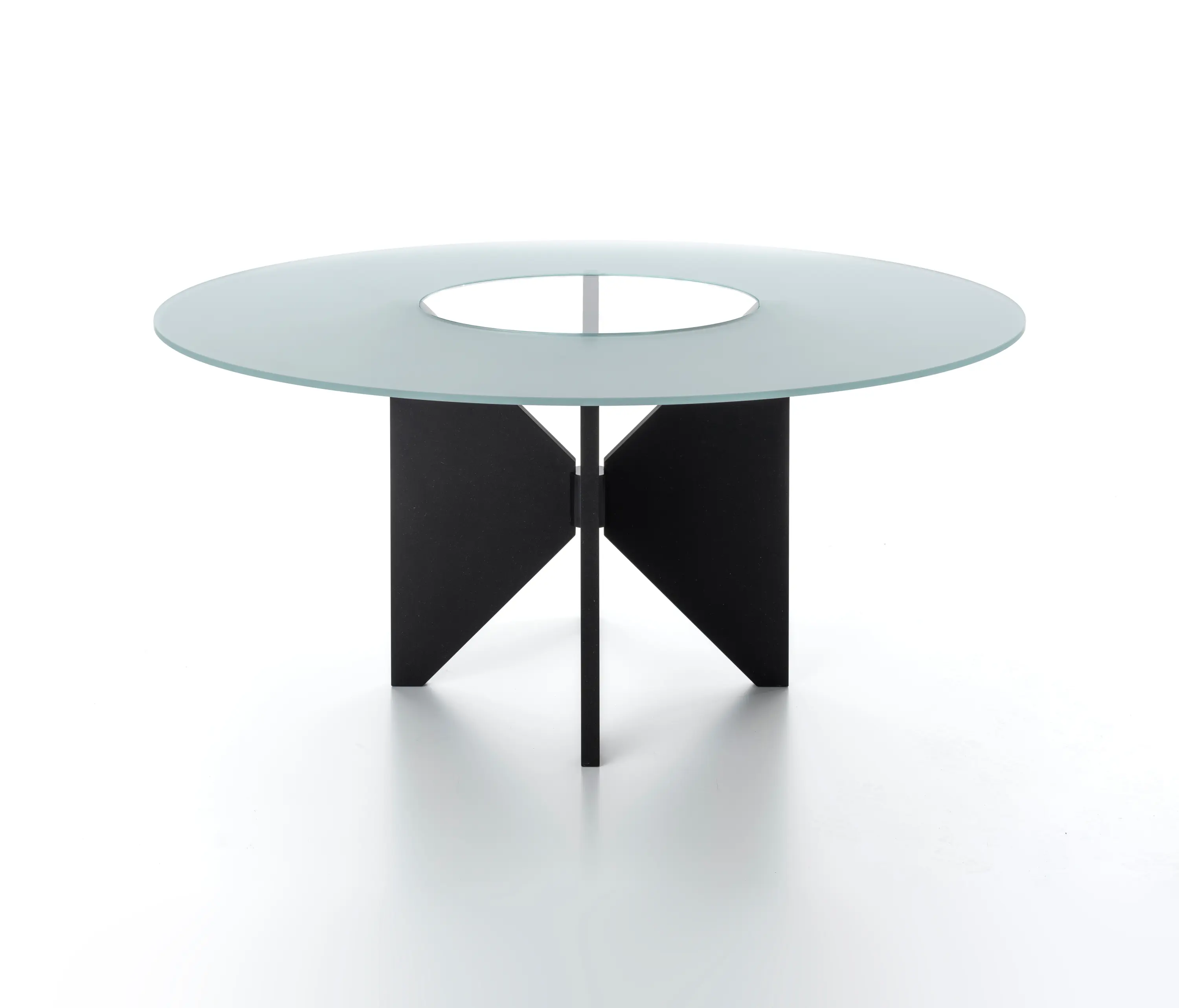
Runder Tisch mit Untergestell aus vier Elementen aus MDF Valchromat® (durchgefärbt und transparent lackiert), befestigt an einem Strukturstahlzylinder lackiert schwarz glänzend. Die Tischplatte ist in 3 Größen erhältlich: cm Ø140-160-180.
Die Tischplatte besteht aus zwei Elementen: einer zentralen runden Ablage (immer aus extraklarem gehärtetem Glas) und einer äußeren Krone, erhältlich in:
- MDF Valchormat®, passend zum Gestell, 16 mm stark. (die Krone besteht aus 4 Teilen)
- geäztes Glas, 12 mm stark (nur für cm Ø140-160)
- Carrara-Marmor 15 mm stark (nur für cm Ø140-160)
Der Tisch ist in der exklusiven MB-edition erhältlich: hellgraues Untergestell mit schwarzen Kanten, Ø160 geätzte Glasplatte.
Konzept
Mit der Kollektion SATURNO erneuert Alias die Zusammenarbeit mit dem Tessiner Architekten, die in den 1980er Jahren begann. Das Tisch- und Couchtischsystem zeichnet sich durch ein architektonisches Design in einem gekonnten Gleichgewicht von Voll- und Hohlräumen aus, das dem Produkt Leichtigkeit und visuelle Dynamik verleiht. Eine solide zentrale Basis kennzeichnet die gesamte Kollektion: vier durchgefärbte MDF-Elemente sind auf einem schwarz glänzend pulverbeschichteten Stahlzylinder verankert. Das Ergebnis ist eine skulpturale Struktur, typisch für Bottas architektonisches Design, worauf Platten in verschiedenen Größen und Ausführungen gelegt werden.
Bei der 72 cm hohe Version besteht die Platte aus einem kreisförmigen Kronenelement und aus eine kleinere runde Ablage aus extraklarem Glas, das wie ein Oberlicht in der Architektur das Licht hindurchlässt, die skulpturale Basis beleuchtet und ein raffiniertes Spiel von Transparenzen schafft.
Beim Couchtisch Saturno 48 ist die Basis proportional kleiner als beim Esstisch und nimmt eine Platte aus Glas oder Natursteine auf.
Dieses Produkt gehört zur Kollektion:

Produktdetails
Material
Untergestell Holzwerkstoff, Holzwerkstoff, Glas, MDF mitteldichte Faserplatte, Tischplatte Glas, Holz
Varianten
2
Zu den Produktseiten dieser Varianten gelangen Sie – einfach anklicken!


Design-Dateien
21
Vertriebspartner
Designer

Mario Botta
Switzerland
Mario Botta, Architect Born in Mendrisio, Ticino, on April 1, 1943. After an apprenticeship in Lugano, he first attends the Art College in Milan and then studies at the University Institute of Architecture in Venice. Directed by Carlo Scarpa and Giuseppe Mazzariol he receives his professional degree in 1969. During his time in Venice he has the opportunity to meet and work for Le Corbusier and Louis I. Kahn. His professional activity begins in 1970 in Lugano. He builds his first single-family houses in Canton Ticino and subsequently all over the world. He has always committed himself in an intense architectural research and since 1996 he is involved as creator and founder of the new academy of architecture in Mendrisio, Ticino where he is Professor and held the directorship in 2002/2003. His work has been recognized with important awards such as the Merit Award for Excellence in Design by the AIA for the Museum of Modern Art in San Francisco; the International Architecture Award 2006 by the Chicago Athenaeum Museum of Architecture and Design and the “European Union Prize for Cultural Heritage Europa Nostra”, The Hague (The Netherlands) for the restructuring of the Theatre alla Scala in Milan; the International Architecture Award 2007 by the Chicago Athenaeum Museum of Architecture and Design for the Church Santo Volto in Turin and the wellness centre Tschuggen Berg Oase in Arosa. His work has been presented in many exhibitions. Among his realizations must be remembered the theatre and cultural center André Malraux in Chambéry, the library in Villeurbanne, the SFMOMA museum in San Francisco, the cathedral in Evry, the museum Jean Tinguely in Basel, the Cymbalista synagogue and Jewish heritage centre in Tel Aviv, the municipal library in Dortmund, the Dürrenmatt centre in Neuchâtel, the MART museum of modern and contemporary art of Trento and Rovereto, the Kyobo tower and the Leeum museum in Seoul, the office buildings Tata Consultancy Services in New Delhi and Hyderabad, the museum and library Fondation Bodmer in Cologny, the church Papa Giovanni XXIII in Seriate, the restoration of the Theatre alla Scala in Milan, the new casinò in Campione d’Italia, the church Santo Volto in Turin, the wellness centre Tschuggen Bergoase in Arosa, the Campari headquarters in Sesto San Giovanni, the winery Château Faugères in Saint-Emilion and the Bechtler museum in Charlotte, USA.


