News
Design
Architecture
People
Materials
Industry News
Product Innovations
Fairs
Videos
News shots
H.O.M.E. Milano ha stile, Hamburg & Düsseldorf
09 May - 03 June 2012
H.O.M.E. Milano ha stile, Berlin & Vienna
10 May - 03 June 2012
Belgrade Design Week
05 - 09 June 2012
DMY, Berlin
06 - 10 June 2012
AZ Awards, Toronto
07 June 2012
Orgatec, Cologne
23 - 27 October 2012
Designer's Open, Leipzig
25 – 28 October 2012
BAU, Munich
14 - 19 January 2013
Author
Alyn Griffiths
London
United Kingdom
List of articles
E-mail contact
Alyn Griffiths | Articles
Hits 10
Park life: the evolving approach to designing urban public space
It could be argued that the pinnacle of urban landscape architecture was reached in seventeenth century France and the French formal gardens or in Britain's philantrophic Victorian public parks in the ninenteenth century. Contemporary urban architects and designers are rarely afforded the same amount of space, money and time as their antecedents. Here, Architonic looks at some recent successes that add value to their surroundings by pushing the boundaries of park design.
Read
Bricking It: innovative applications of man’s most trusted material
Brick is one of the most ancient and familiar building materials known to man, and its strength, character and flexibility of use continue to attract architects working on innovative contemporary buildings. Architonic examines some key projects that demonstrate the benefits of building with brick.
Read
Support Structures: architecture's role in the healing process
Good architecture creates environments that are, among other things, enjoyable to spend time in and practical to use, and in no scenario is this more important than the provision of treatment or support for those dealing with illness or trauma. Architonic examines some of the ways in which intelligent architecture and design can help to ensure a positive prognosis for the future of healthcare by creating buildings that are good for body and mind.
Read
Mind the Gap: architects fitting extraordinary buildings into small spaces
Every city evolves differently, according to fluctuations in population and wealth, changes in industry and other social and economic factors. As old buildings are replaced, or new ones constructed, spaces between these buildings appear or alter; spaces that are either promptly integrated into the fabric of their environment or are left dormant and unused. Architonic examines how contemporary architects are capitalising on the benefits of these forgotten alleys, gaps and passages and transforming them into practical and desirable urban property.
Read
Sporting Chance?: the challenge of legacy-building in international stadium design
As the cost of hosting major sporting events continues to rise, the need for something positive to be left behind once the fun and games are over becomes ever more vital. Architonic examines past and future events and the differing approaches to planning, designing, adapting and repurposing venues and infrastructure in order to create a medal-winning sporting legacy.
Read
Help the Aged: innovative adaptive reuse in architecture
'Waste not, want not' is an expression that has become increasingly pertinent in recent years as economic conditions have forced many of us to tighten our belts and make the most of what we have, rather than constantly replacing old with new. This attitude of thrift extends to architecture in the form of adaptive reuse – the conversion of an old building into something better suited to contemporary requirements. Here, we examine some recently completed, ongoing and future projects that show how imagination and intelligent design can deliver striking transformative effects.
Read
Leading lights: current and future applications for new lighting technologies
Few aspects of product development have seen more innovation in the past decade than lighting design. Legislation and consumer demand have hastened the evolution of energy efficient solutions and programmable software now enables infinitely customisable lighting scenarios. Architonic examines some shining examples of products and projects that demonstrate the diverse and unusual possibilities offered by these new technologies.
Read
Spectacular Vernacular: contemporary applications of craft-based building methods
There was a time when context was everything in construction. Local materials were transformed by the ambition and skill of the builder into a functional, stylistically appropriate structure. In the face of an, at times seemingly inexorable, movement towards a homogenous, global design language in architecture, a number of architects have recently completed projects that embrace low-tech, craft-based building methods to add real environmental and cultural value.
Read
Hole Lot of Sense: smart uses for perforated façades and partitions
Perforated walls, panels and screens have been used for centuries as a way to control the level of light entering a building or to offer privacy to the occupants. The functions of perforations have remained largely the same, but the materials and methods of manufacture have altered considerably. No longer cut or carved by hand, developments in computer-controlled technologies mean that detailed patterns can now be quickly and easily etched into various materials for interior or exterior use. Architonic looks at some recent projects demonstrating the contemporary effects that can be achieved using perforated materials.
Read
Neo Geo: geodesic construction in contemporary architecture
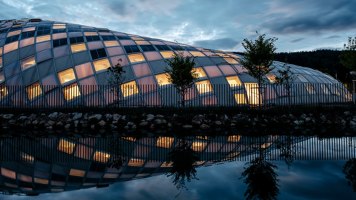
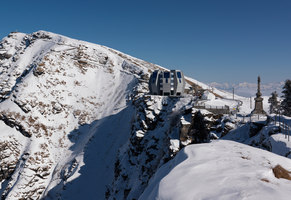
The principles of geodesic construction were developed by the pioneering American architect and engineer R Buckminster Fuller in the middle of the last century as part of his efforts to use science and technology to address universal issues. His vision has inspired successive generations of architects and geodesic designs have played a fundamental role in defining the architectural landscape of the past few decades. Architonic takes a look at some recent projects that combine the brilliance of Buckyʼs ideas with twenty-first century technology, resulting in complex yet efficient structures with a futuristic aesthetic.
Read
Top
Architonic sucht ab sofort ArchitektInnen als Übersetzer mit guten Deutschkenntnissen und als Muttersprache eine der folgenden: Dänisch, Holländisch, Norwegisch, Portugiesisch, Russisch, Schwedisch, Türkisch.
Download
Architonic zoekt per direct, als versterking van ons internationale verkoopteam een Sales Representative (m/v) voor de Benelux. U heeft een affiniteit met Design en Architectuur en Nederlands is uw moedertaal, goede talenkennis van Engels, Frans en Duits in woord en geschrift strekken tot aanbeveling.
Download
Architonic è alla ricerca con lo scopo di rafforzare il nostro Sales Team, da ottobre 2012, di un responsabile commerciale per l'Italia che abbia passione per il design e l'architettura e sia di madrelingua italiana.
Download